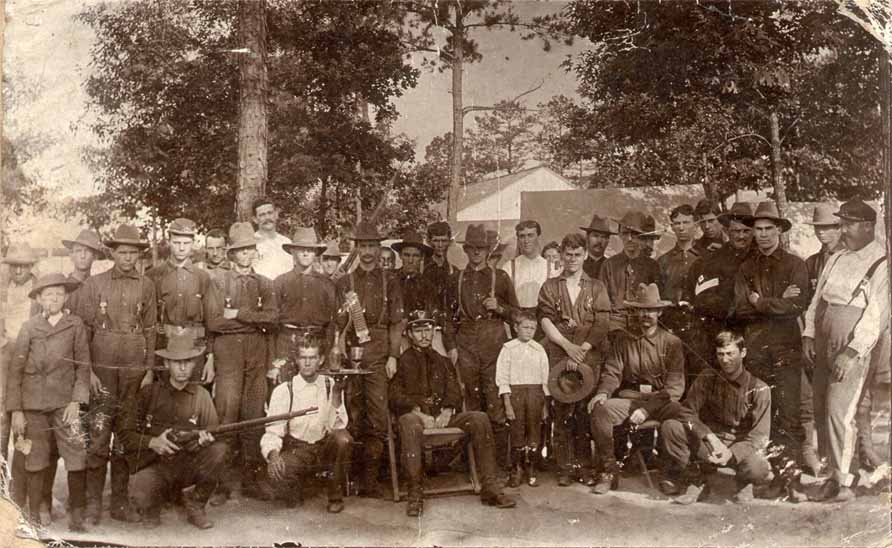
Following is an extract from News and Sun, dated 1894.
Over a half a century ago, in 1836 to particularize the date,
in the town of Fort Gaines, Clay County, Georgia, a military company was
organized, known as the Fort Gaines Guards. Long before the murmurs of
discontent were heard through the land to finally culminate in the din and
carnage of war between the states, the grandsires of many who today from the
rank and file, fired with patriotic zeal, enlisted; a company was formed and
christened with the name which its successors bear to this day.
Soon after the company was formed the Indian War broke
out and under the command of its first organizer, Col. J. E. Brown it went to
fight the red men. Returning home after some loss and many hardships, it
was not long afterward enlisted in the war against Mexico and figured
prominently and gallantly in the campaign that resulted in the defeat of the
Mexicans.
Although for years after this no call was made upon
this company to go into active service with commendable pride and zeal the
company kept intact, the Southern states seceeded from the Union in 1861 and the
Guards went into the great and bloody struggle for which the experience with the
Indians and the Mexicans had been a training school.
On the 11th of June, 1861, with R. A. Turnipseed as
their Captain (he was replaced by J. G. Webb) with full ranks composed of the
best young men in every respect that this section afforded, the company
rendevoused at Atlanta and then with one-hundred and twenty-one men marched away
to the front and was mustered into service as Company D, in the 9th Georgia
Regiment of Tige Anderson's Brigade Longstreet's Corps. There it remained
through the war until at last, the Cause, not lost but the war ceased-for
surrender was necessary. Banners were furled and the heartsick and
footsore, only thirteen of the original one-hundred and twenty-one remained to
tell the tale. Following their colors into the thickest of the fight at
the Second Battle of Manassas, enduring the hardships of the Yorktown campaign
in the three battles of Suffolks -- through the Seven Day's fight around
Richmond under iron storm at Malvern Hill -- at the battle of Seven Pines --
through Maryland campaigns -- at Chancellorsville, Fredericksburg, Sharpsburg,
Fairfax Gap, on to Winchester, Gettysburg, Funkstown, Hagerstown, Brandy Station
and Culpepper Court House.
They were in the campaign of East Tennessee, London,
Knoxville, Bean Station: back to Virginia they went and were in the second
Battle of the Wilderness, Spottsvania Court House, Cold Harbor, the charge of
Fort Harrison, Derbytown Road, Bermuda Hundred, New Market Heights, Petersburg,
Farmville and at Appomattox when bravery and endurance could no longer sustain
this immortal regiment the remnant of their once gallance company, overpowered
but not defeated -- laid down arms and returned in sorrow to their desolate
homes, sick and disheartened over the downfall of their cherished land of
liberty.
(Mrs. B. C. Brown states that T.E.M. Brown, born July
10, 1846, left with this group before his 15th birthday, was one of the 13
original 121 to surrender at Appomattox. After four years of war he
returned home before his 19th birthday.)
In 1868 the Fort Gaines Guards were reorganized under
the same name and with Col. R. A. Turnipseed as their Captain. Five years
later in 1873, Capt. E. A. Morris commanded and served until his death which
occurred in 1874.
J. G. Webb was then elected and served until 1877, at
which time he resigned and was succeeded by James Mandeville, who after a short
term of office also resigned. In the spring of 1884 Col. J. D. Rambo was
elected to the Captaincy, resigned and was followed by Dr. C. T. Morris, elected
in the spring of 1885, served until January 1886, when moving to another state
he was succeeded by T. J. Morris, who was elected in Sept. 1886 and served until
March 1888. He moved to another state and was succeeded by G. R. Sutlive.
In 1889 Capt. Sutlive tendered his resignation and was followed by R. M. Dillard
who had in the meantime returned to Fort Gaines. He is the present
commander and, in point of age and service there is not a more famous record
that that of the Fort Gaines Guards. The fact that as the years roll on
and time with its changes gives new material to the rank and files, the old name
that it bore during the days that tried men's souls is still held and claimed as
a sacred heritage and is strong evidence to prove that the name was never
dishonored by the old Guards and the new are proud to bear it.
Though the present command and company has had no
opportunity of displaying its valor on the battlefield, and we fervently trust
it may never do so, yet in honorable discharge in competition in camps and at
home, it has shown evidence that it has the same spirit as of yore and the sons
at the call of duty would anser as promptly as did their fathers before them.
At present the company numbers 33 men officered by T. J. Morris, Capt. and Geo.
D. Speight, 1st Lieut. Geo. Brown, 2nd Lt.
The above copied by Mrs. Kirby-Smith Anderson,
Historian Ga. Div. U. D. C., Madison Ga. from an article dated 1929.
Following the above period E. A. Greene on his return
from college was elected 1st Lt. and Lewis Cohen, 2nd Lt. It was decided
to organize a detachment at Bluffton, which was done and Lt. Greene made weekly
trips to train them.
When the Spanish-American War broke out a detachment of
more than twenty volunteers with Lt. Green joined Company A, 1st Ga. Volunteers.
They saw service at Chickamauga, Part, at Knoxville, Tenn. and were mustered out
in the fall of 1898.
Captain Morris was promoted to Lt. Col. and was
succeeded as Captain by B. T. Castellow, who later resigned and was succeeded by
John Burnett who remained as Captain until 1909 or 1910 when the Guards
disbanded.
"History of Clay County, Georgia" - pages 34-35
For a close up of the men's faces you
can click on the image below
it is divided into 4 parts.
For the full large image (1.08mb) you can
Click here
|
The Fort Gaines Guards (1896-1897?) This image is from a scan of a 5x8 inch
photograph that I inherited from |
Chester
Gavin III
I would like to Thank Chester on behalf of all the
Clay Co.
Researchers for sharing this wonderful old Photograph.
Thanks Chester!!
*If you can identify someone in this
photo please let
Chester or
the
Webmaster know.
Transcribed and submitted by Donna Eldridge (DonnaEldrid@aol.com)
 |
 |
|||||
|
Clay Co., GAGenWeb Project
|
||||||
|
|
||||||
|
||||||
|
©Copyright 2007
|
||||||