Hickory Grove & Robley
Vanished Towns: Hickory Grove and Robley Reprinted from "The Georgia Post."
By Billy Powell
Billy Powell, author and religious columnist for “The Georgia Post,” enjoys researching and documenting local history.
Hickory Grove
Hickory Grove was once a thriving, bustling hamlet in western Crawford
County, located just east of the Upson County line. The community, named after
the Hickory trees growing in the area, existed as early as 1834, but first
appeared on the Georgia map in 1855. Although signs marking the boundaries of
“Hickory Grove” are placed along Georgia Highway 80 (the first, a half-mile from
Upson County line, and the second, a full mile from Upson line), the town is no
longer reflected on the Crawford County map or recognized by county Planning and
Zoning. Sitting near the center of Hickory Gove was Larry and Peggy Gautney’s
store, located at the corner of Highway 80 and Olive Grove Church Road. This
convenience and gas store, now under new management, is called Pleasing Foods.
Hickory Grove had a post office as early as the 1860s, as the U. S. Postmaster
General appointed Mrs. Elizabeth Northrop Smith the postmistress of Hickory
Grove in 1867. Mrs. Smith was the matriarch of the prominent Smith family. Her
husband was Dr. William J. Smith, a prominent Crawford County physician.
According to historical society records, the Smith Cemetery is located on the
north side of Highway 80, about half-way between Pleasant Hill Church Road and
Billy White Road. Because of heavy undergrowth, we were unable to locate the
cemetery, but will try again during the winter months when snakes are dormant.
Anyone having knowledge of Smith cemetery, please notify the “Georgia Post” at
478-836-3195. There were two cotton gins, one gristmill, and one flourmill in
Hickory Grove for several decades following the Civil War. The school at
Hickory Grove was Jackson Academy. It was advertized in the “Georgia Messenger”
in 1834 and was still operational during the Civil War years. Its principal in
1834 was Adam T. Holmes (1803-1870), who at one time pastored the Baptist Church
in Macon. During the late 19th century, Hickory Grove was rivaling
the county seat of Knoxville in the east in population and business activity.
However, the coming of the railroad to Roberta in 1888 caused a population shift
toward the center of the county. Consequently, Hickory Grove and Knoxville began
to decline and today the population center is Roberta.
The Plum-Nearly Store
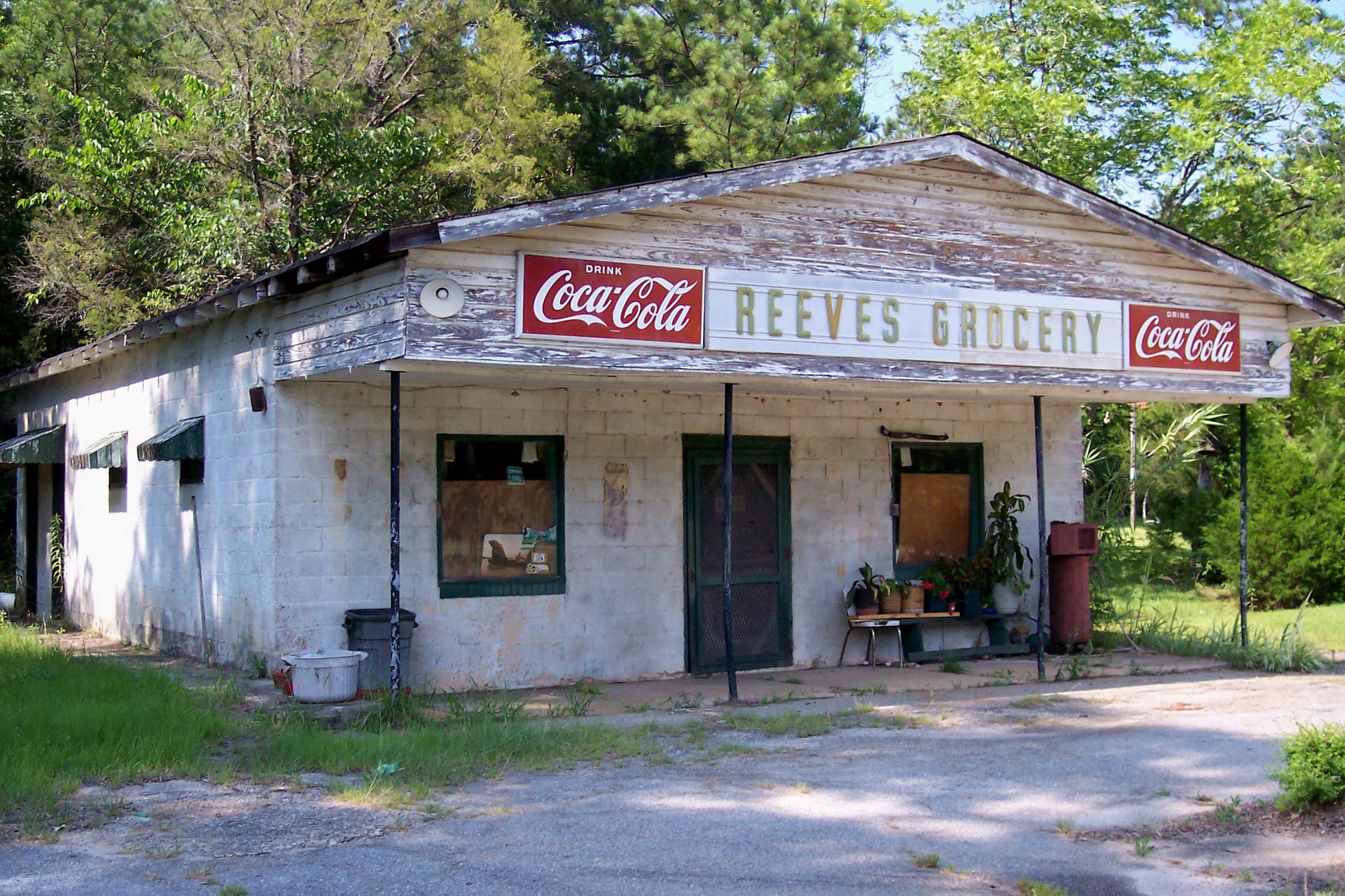
An age-old conversation piece involves the old Reeves Grocery
Store on Highway 80 that sits one-half mile west of Hickory Grove and about 10
miles west of Roberta. In 1947, Charlie Reeves purchased a house and converted
it into a combination country store and family home. Because the store portion
of Reeves house was said to straddle the Upson-Crawford County lines, I call it
the Plum-Nearly Store. It was plum-nearly in Upson County and plum-nearly in
Crawford County. When Highway 80 was widened circa 1960, the combination
store-house was within the highway right of way and had to be torn down. A new
store building was built of concrete blocks and placed completely inside the
Upson County line. This eliminated any overlap of the structure inside the
Crawford County boundary line. This is the building you see today. This
building and the surrounding property are currently owned by Jackie Blalock, the
daughter of Charlie Reeves. Crawford County historian Sidney Goodrich tells the
true story about the Southern Bread man named Phillip Jenkins, who made
deliveries to his country store at Gaillard. The year was 1951 and the sales
tax had just been enacted into law. One day, while restocking Sydney’s bread
rack, the bread man noticed Sidney figuring the sales tax on some merchandise.
The bread man said, “Sidney, if you think you’ve got problems with the sales
tax, you need to consider the dilemma of Mr. Reeves who runs a country store up
on Highway 80. His store straddles two counties. When he sells a coke on one
side of the store, he owes sales tax to Crawford County. When he sells a loaf of
bread on the other side, he owes tax money to Upson County.” D’Lyn Jones,
Crawford’s Chief Appraiser, graciously researched the property lines at my
request and advised that Upson County currently receives property taxes for the
second Reeves store built around 1960 and its one-acre of land (now completely
in Upson County) while Crawford County receives property taxes for the remaining
25 acres. Thank you D’Lyn for your capable assistance!
Hickory Grove Slave
Conspiracy of 1860
A number of slave owners operated large plantations at Hickory Grove.
Prior to the Civil War, a bloody and deadly slave insurrection almost
took place at Hickory Grove. The fomenter of the insurrection was a local
tinsmith named Amos V. Dreher, a native Pennsylvanian and a staunch
abolitionist. Dreher, a white man and slave owner himself, secretly colluded
with local slaves and persuaded them to take advantage of the absence of the men
on election day. The uprising was scheduled for Tuesday, November 8, 1860,
while the men were at the Knoxville county seat casting their votes in the
national, state, and local elections. At the time, the republican candidate for
President, Abraham Lincoln, was campaigning to abolish slavery in the South.
Dreher’s plan called for the slaves to murder all the whites remaining at
Hickory Grove while the men were away at Knoxville. Fortunately for the whites,
one of the co-conspirators informed the plantation owners of Dreher’s plans.
Dreher was charged with attempted slave insurrection and sternly warned he would
be hung from the nearest tree if he repeated the offense.
Robley
The territory of Robley begins about 1.3 miles east of Hickory Grove--at
the point where Hopewell Road runs into Georgia Highway 80. The general area of
Robley forms a triangle: its horizontal base being Highway 80, the vertical side
being the lower end of Mount Carmel Road, and the hypotenuse being the western
tip of Hopewell Road. Robley was mentioned in area newspapers as early as 1882
and first appeared on the Georgia map in 1895, but like Hickory Grove, it is no
longer recognized as a town by county government.
Robley Dunglison Smith
Robley is believed to be named after Robley Dunglison Smith (1850-1910), a scion
of the distinguished Smith family of Crawford County, at the height of his legal
and political life, during the early1880s. Robley Smith attended the University
of Virginia Law School. He returned to Crawford County in 1872 and was appointed
Clerk of the Inferior Court. From 1873 to 1877, he served as Clerk of the
Crawford County Superior Court. In 1877, he was admitted to the Georgia bar to
practice law. He was elected state senator and represented the 23rd
district during the 1882-83 legislative term. In 1894, he was named chairman of
the Democratic Executive Committee of the 23rd Senatorial District. A
year later, in 1895, Robley Smith’s friends attempted unsuccessfully to have him
nominated to a judgeship on the Macon Judicial Circuit. Robley Smith died in
1910 from complications brought on by typhoid fever contracted years earlier. He
was buried in the Methodist Church Cemetery in Culloden, Georgia. Robley Smith’s
parents were Dr. William J. Smith (1815-1860) and Elizabeth Northrop Smith
(1815-1897). William J. studied medicine in Philadelphia, Pennsylvania, under
Dr. Robley Dunglison (1789-1869), the personal physician of U.S. Presidents
Thomas Jefferson and James Madison. William J. named his third son, Robley
Dunglison Smith, after Dr. Dunglison. William J. and Elizabeth Northrop Smith
had two other sons:
Historic Robley Landmark
A major landmark at Robley is the stately two-story house built 187
years ago, in 1823, by John Bryan Williams, who also owned 1300 acres of land.
The house is located on Hopewell Road, just west of the Mount Carmel Road
intersection. Williams was the grandfather of Tryphena Moore (1823-1905), who
grew up at Robley. Tryphena’s parents were George Moore Sr. and Rachel Williams
(John B. Williams’ daughter). Tryphena Moore was named after the Tryphena
mentioned by Paul in Romans 16:12, who “labored in the Lord.” Such was the life
of Tryphena Moore, who lived an exemplary Christian life and was an inspiration
to many. Tryphena Moore married Dr. William Asbury Mathews. She is the maternal
great grandmother of Albert L. Jr. (Buddy), George, and Joe Luce of Fort Valley,
the former owners of Blue Bird Body Company; and Beth Mathews Collins and Mary
Mathews Humble of Fort Valley. Her great, great granddaughter, Helen Rhea Luce
Stumbo of Fort Valley, provided Tryphena Moore Mathews’ photograph for this
story. A caravan of Moore family members departed from Knoxville, Georgia, in
1854, headed for Texas to acquire land. While in Texas, they contracted Asiatic
cholera. The epidemic nearly wiped out the entire family, the only survivor
being Tryphena. Mrs. George W. Mathews (Tryphena’s daughter-in-law and the
maternal grandmother of Buddy, George, and Joe Luce) chronicled this tragedy in
her book, “Light after Darkness.” Incidentally, the mother of Buddy, George and
Joe was named Helen Tryphena Mathews. She married Albert Lawrence Luce Sr., who
built his first school bus in 1927 and grew Blue Bird into the nation’s premier
bus manufacturing company. Dr. Joshia Hilsman purchased the house from the
Williams family and later sold it to Walter White. The present owners are
Bernard and Clarissa Price. Other landmarks at Robley are Bethel Baptist Church
and the Hollis Farm. Up Highway 80 from Robley is the Museum of Southeastern
Indians on Julia Jordan Road. It is owned and operated by Mike Stokes. Mike has
been collecting Indian artifacts and relics for several decades and possesses
one of the finest collections in the southeast. His museum is jam-packed with
fascinating displays. Call Mike at 478-836-2696 to schedule a tour.
Nostalgic Tour of Oak Grove
and Robley
On Thursday, June 17, 2010, Paul Spillers, a former Crawford County
Commissioner and owner of the Central Georgia Tractor Company in Byron,
organized a tour of Oak Grove and Robley. Oak Grove is about 3.5 miles west of
Robley. In addition to myself, Paul invited Billy Harris, former state senator,
1983-1993, his brother, Charlie Frank Harris, a dairy farmer, and Crawford
County historian Sidney Goodrich. We all assembled at the Musella Baptist Church
parking lot at 9 a.m. Soon, we headed down Hopewell Road in three trucks. I was
riding with Paul who narrated the journey. Behind us in another truck were Billy
and Charlie Harris, and following in the third truck was Sidney Goodrich. The
trip was primarily for my benefit as the other men grew up in Crawford County
and knew the landscape well. As we slowly rolled along, Paul would point out
historic landmarks as they came into view, like the New Lebanon Baptist Church
who built on land donated by Paul Spillers. Paul named family-after-family who
once farmed the pristine land in this scenic countryside of Crawford County:
pioneers such as the Andrews, Blasingames, Wilders, Hortmans, Woods, Greens,
Pressleys, Spillers, and Harrises. We passed the site of the old schoolhouse
Paul attended at Oak Grove, which resided on the corner of Oak Grove Road and
Hopewell Road. Paul smiled and said, “My good friend, Hazel Chancelor Mathews,
now age 95, lived right across the road from the old schoolhouse.” Paul
chuckled about the town barber, Cicero Spillers, his first cousin, who cut the
hair of every male in Oak Grove in his home for ten cents a head. Paul also
reminisced about the old baseball field on Oak Grove Road, and told of the
intense baseball rivalry that existed between Oak Grove and Musella. “After the
games, the teams went swimming in a nearby creek,” he said. I took pictures of
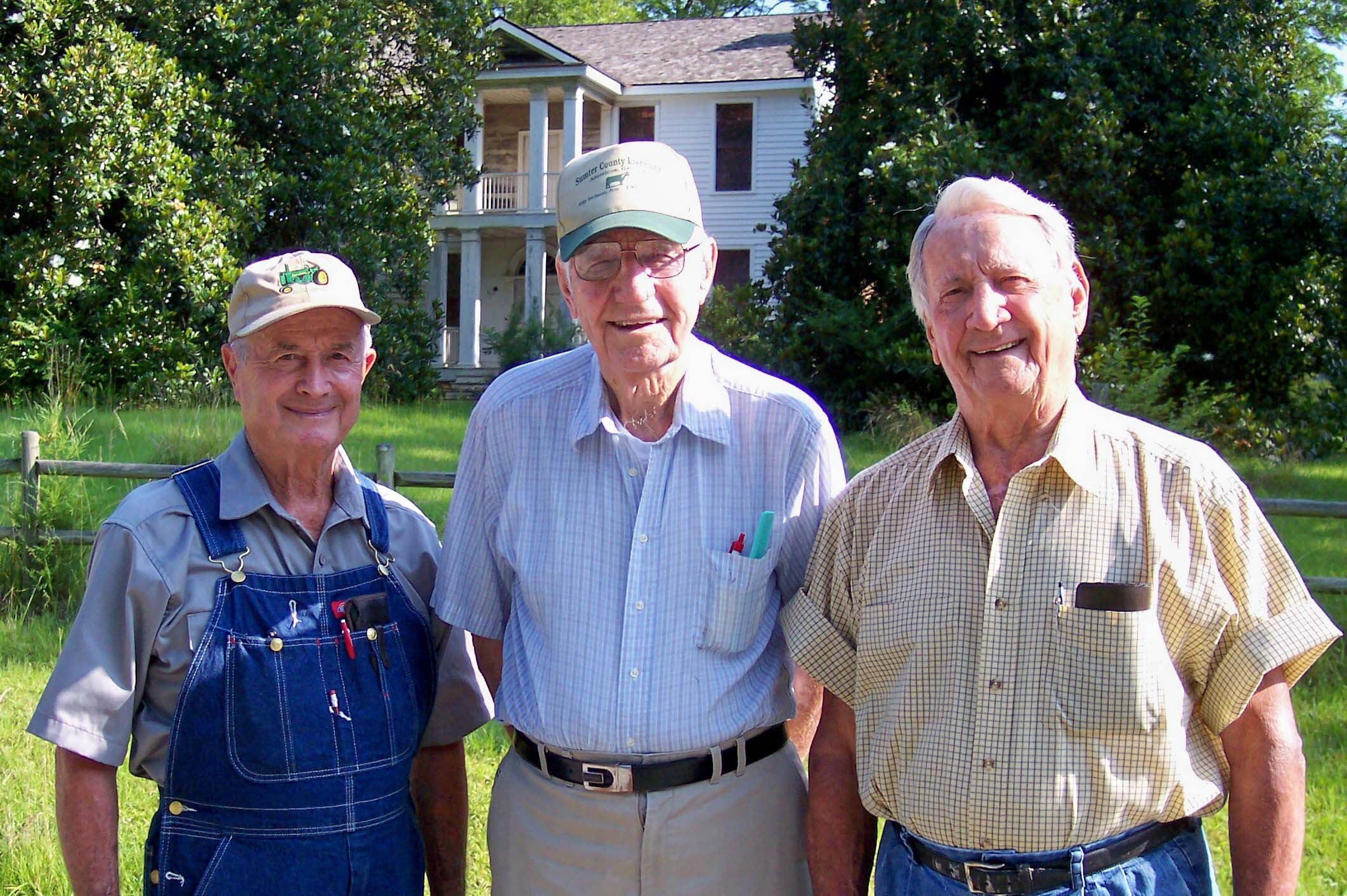
the “Oak Grove Gang” (Paul, Billy, and Charlie Frank) in front of the 187
year-old Williams’ home on the western end of Hopewell Road. On the return to
Musella, we stopped by the old Harris home, built in 1860. Billy Harris
remarked, “Eight of the ten Harris children were born and raised here, including
me and Charlie Frank.” Charlie Frank stated that “the Harris family farmed 600
acres the hard way--by mule and plow.” I encourage everyone to take a trip to
Hickory Grove, Robley, and Oak Grove. God’s beauty is right under our noses.
Enjoy it while you can!
My appreciation to Attorney Gordon Smith of Savannah, a noted historian who has researched and written extensively on the Smith family and Crawford County, and to local historian Sidney Goodrich. Attorney Smith also shared photos from his collection.
A huge thanks goes out to Mr. Billy Powell for sharing this information and photos with us!
Click on the photos for a larger view...
|
The "Oak Grove Gang" pictured in front of the 1823 Williams Home at Robley. L-R are Charlie Frank Harris, Paul Spillers, and Billy Harris. |
Tryphena Moore Mathews |
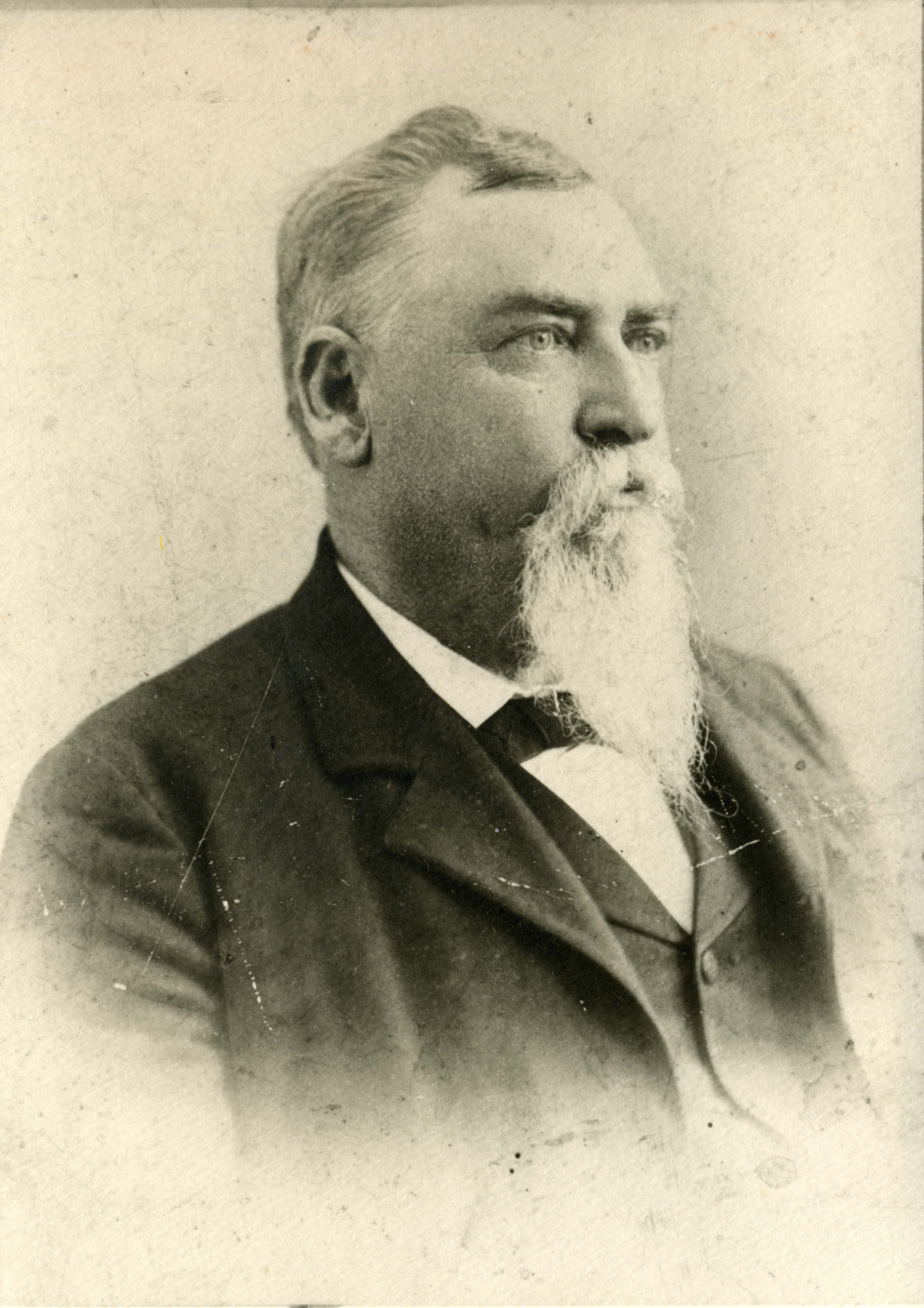 Robley Dunglison Smith |
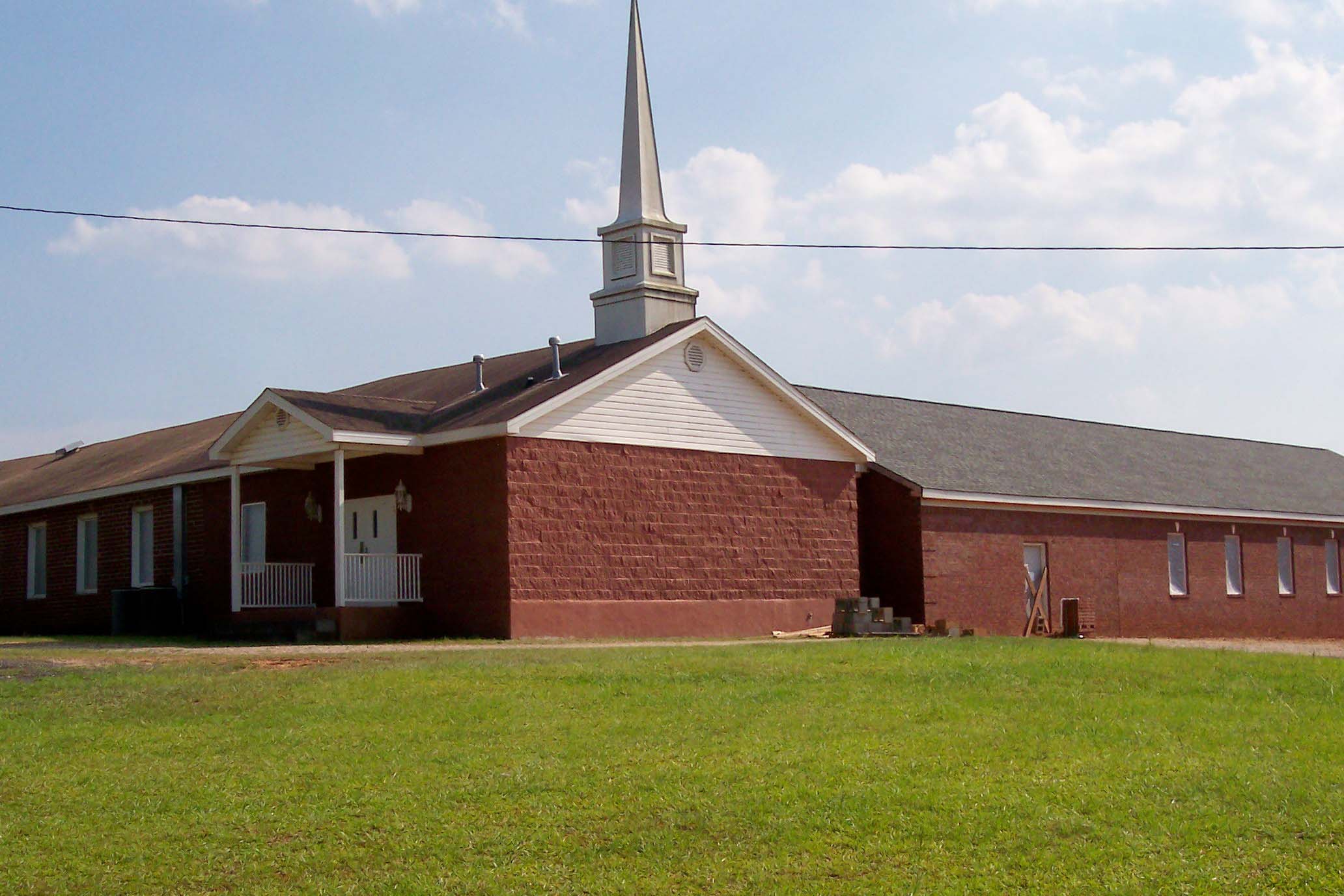 Bethel Baptist Church |
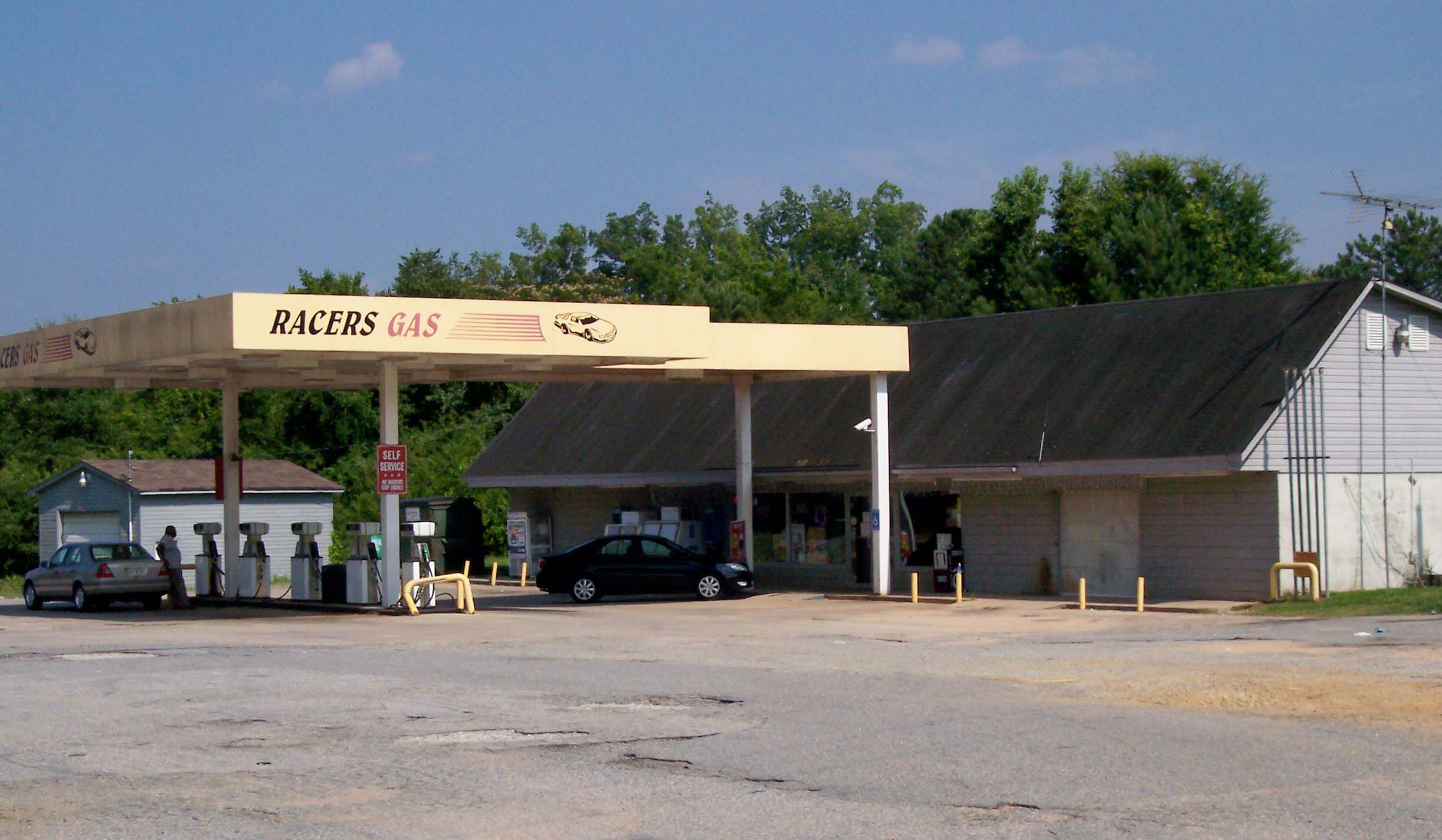 Gaultney's Old Store |
 Plum-Nearly Store |
 Old Williams House |
Lemuel and Mary (Dickson) Smith's son Dr. William Jackson Smith
(1815-1860), his wife Elizabeth (Northrop) Smith, their son William T.
Smith (who died in 1864 as a cadet in the Georgia Military Institute
Cadet Brigade at Milledgeville)
As you probably know, Hickory Grove (Robley Community) was the scene of the
Hickory Grove Slave Insurrection in 1860, fomented by Amos V. Dreher.
Dr. James Dickson Smith, also a son of Lemuel and Mary (Dickson) Smith, is
buried in Rose Hill Cemetery in Macon, Georgia, with his family. He first
practiced in Hickory Grove (Robley), later in Knoxville, then in Forsyth,
and finally in Macon (although he died in Atlanta). He was a co-organizer
of the Medical Association of Georgia (MAG) and was an assistant surgeon in
the 33rd Regiment Virginia Infantry, Stonewall Brigade.
Submitted by Gordon Smith ←
This page was last updated Tuesday, July 27, 2010
Copyright ©
Kim Gordon ←
Webmaster
All Rights Reserved