|
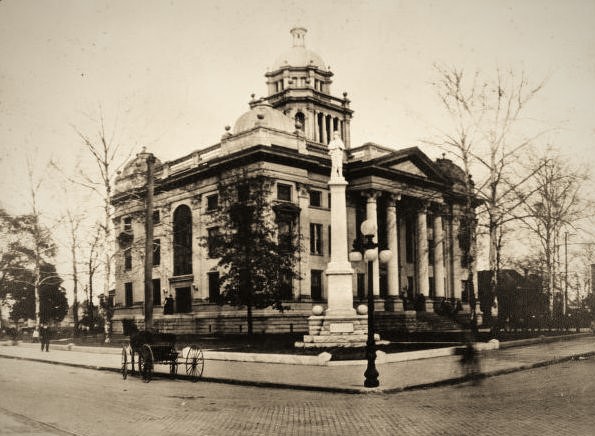
Lowndes County GA Courthouse ca 1900 |
Lowndes County GAGenWeb A proud part of GAGenWeb
|
|
Lowndes County GA Courthouse ca 1900 |
Lowndes County GAGenWeb A proud part of GAGenWeb
|
If you have additions or corrections, please let me know.
First Settlers - Creation
of Lowndes County
In
1821 four settlers moved to that section of Georgia which is now known as
Lowndes County. Sections to the north had been settled and several counties had
been laid off. The country into which these four settlers moved their families
was a wilderness and Indians were numerous.
The first settlers found a
region of gently rolling uplands with extensive forests of pine and oak,
flatwoods of longleaf pine and wire grass, and an undulating southern section
dotted with lakes and lime sinks. The fine sandy loam of the northern part
promised good crops, and a soil recognized as productive for farming and stock
raising stretched from the Withlacoochee along the south side of Cherry Creek to
Skipper Bridge and beyond to Cat Creek. The newcomers marveled at the expanse of
yellow pine.
The first settlers were James Rountree, Lawrence
Folsom, Drew Vickers and Alfred Belote. They each brought their families and
made the journey in covered wagons. Each man selected his lot of land and
proceeded to erect modest homes. Lawrence Folsom and Drew Vickers located in the
northern section of the county. They chose the high ground which was good for
general farming and excellent for raising stock.
The Coffee Road was the first
major thoroughfare for settlers into south Georgia. Commissioned by the state in
1822, General John Coffee and the militia cut the road from Jacksonville in
Telfair County to Duncansville in Thomas County. One man who realized the
opportunity opened up by the Coffee Road was Sion Hall. He lived in Irwin County
at the time of the 1820 census. Hall and his sixteen-year-old son Enoch had come
into the new region to select a homeplace on the route. They "rambled around a
while looking for a good spot to settle to build a house and a store,"
eventually deciding upon a site, Lot No. 271 in the northeast section of
District 12, about two miles north of present Morven in Brooks County. Sion Hall
brought in a sawmill that he had, along with a "good many" slaves and his
horses, and cleared the land and with the dressed lumber build a home on the
west side of the Coffee Road. He then brought in his family and household goods.
After other settlers began to arrive, Sion Hall build a store in a pine thicket
across the road from his house thus establishing the first commercial enterprise
in the county, and he provided for the needs of newcomers and travelers. The
first session of court in Lowndes County was held at the home of Sion Hall,
where the judge, jurors and the spectators sat upon logs arranged in the yard.
Hamilton W. Sharpe, who clerked in Sion Hall's store for several years,
eventually purchased Mr. Hall's interest in the store. Hamilton W. Sharpe was
very active in establishing the first post office in Lowndes County in 1827 and
became the first post master. The post office was known as Sharpe's Store.
Soon after the opening of the
Coffee Road, other settlers rapidly moved into the area. This section of Georgia
was very fertile, as it is now, and it was easy to make a prosperous home in the
new and undeveloped land. In the space of three or four years the country had
become thickly settled. About 1823 John Bryan homesteaded upon land in the fork
of the Okapilco and Mule creeks, and Washington Joyce farmed east of the Little
River where he put into operation a ferry at Miller's Bridge.
In 1825 it was decided to
petition the legislature to create a new county. The name selected for the new
county was Lowndes, and at the meeting of the General Assembly that year the act
creating Lowndes County was passed.
In deciding upon a name for
their county, these early settlers went outside of their own State and elected
to choose Lowndes, in honor of William Jones Lowndes, one of the distinguished
sons of South Carolina. William Jones Lowndes was the son of Rawlings Lowndes,
who was a leader in the affairs of South Carolina during and after the
Revolutionary War. The man for whom Lowndes County was named was noted as a
learned scholar and for his mildness of disposition. He was not vigorous in
health and was forced to decline the honor of having his name placed before the
people as a candidate for the presidency of the United States at the time of the
election of James Monroe for the second term.
Lowndes County was created by
cutting Irwin County into two parts. The northern portion remained Irwin, while
most of the southern portion was called Lowndes. The new county, when originally
marked out, was sixty-two miles from north to south and forty miles from east to
west. It contained 2,080 square miles. It was bounded on the north by Irwin
County, on the east by Ware County, on the south by the State of Florida, and on
the west by Thomas County.
Settlers continued to move
into the newly formed Lowndes County. Many came from South Carolina; for
example, the Howells loaded their household goods in wagons, gathered together
their children and their children's children, their slaves, and their stock,
left the Carolina Barnwell District, and located in the southeast section of the
county around Howell. Jesse Carter settled on Lot No. 375. District 11, to the
east; James McMullen on Lot No. 142, District 15, in the southwest; and Thomas
M. Dees in Lots No. 26 and 27, District 11, near Mud Swamp. A. B. Shehee and
Samuel Swilley lived in the Mud Swamp area which also proved to be good farm
land. Samuel Swilley had a substantial log house on the edge of the woods and
log cabins for his slaves in the midst of his corn field. He possessed a pond
with a mill whose water power he used to grind corn, to saw logs and to gin
cotton.
James Edmondson was born in Warren County, Georgia,
and grew up in Bulloch County. During the winter of 1827-1828 he came to Lowndes
with his wife and two children, living first on Lot No. 362, District. He later
moved to a new homeplace about four miles east of Hahira.
Franklinville
Included in the act to create Lowndes County, Lawrence
Folsom, Sion Hall, William Blair, John J. Underwood, and Daniel McCauly were
appointed commissioners for selecting a public site in the new county.
Eventually the commissioners decided on a permanent site and in 1827 the
Assembly declared Franklinville, Lot No. 20, District 11, to be the county seat.
The commissioners had chosen a place adjacent to a good spring on the
Withlacoochee River near Skipper Bridge and close to the homes of Elias Skipper,
Francis Rountree, and a number of Parishes, a few miles east of what is now
Hahira. William Smith, who later opened the first hotel at Troupville, was the
first settler of Franklinville. Mr. Smith was appointed postmaster at
Franklinville in 1828 and served there until he became postmaster at Troupville
in 1837. John J. Underwood, attorney-at-law, John and James Matthis, Martin
Shaw, who was sheriff of Lowndes in 1836-1837, and Aaron Smith were also
Franklinville residents. Franklinville was made up of only a few houses and
three log buildings, the court house, the post office and a store. Residents of
the area still did most of their trading in Tallahassee, St. Marks, and Newport,
Florida. Court convened for the first time in the new log public building at
Franklinville for the May term 1829. Franklinville proved unsatisfactory both as
a business location and as the public site, and by 1833 a new county site was
decided upon.
Lowndesville - Troupville
By 1833 the appointed commissioners had all resigned
or refused to act, and the justices of the inferior court appointed new
commissioners to fix upon a new county site. First selected was Lowndesville in
Lot No. 109, District 12 near Ousley, south of U. S. Route 84. Lowndesville
proved to be no more satisfactory than Franklinville, so once more the citizens
of Lowndes shifted the county seat. A new commission composed of Samuel M.
Clyatt, William Folsom, William Henry, Jarrel Johnson, John Knight, John Lindsey
and Henry Strickland favored a location at the junction of the Withlacoochee and
Little Rivers, and in 1837 Troupville became the county site.
Troupville was named in honor
of Governor George M. Troup, one of Georgia's most noted governors. Governor
Troup was a passionate defender of States Rights, and thought nothing of telling
the United States to mind its own business when there was trouble in the State
with the Creek Indians and the Federal Agents wanted to come in and take part in
settling the difficulties.
During this time many new
settlers were coming in and the entire county was being rapidly developed. There
were several splendid farms near Troupville as well as in other parts of the
county, and the residents of Lowndes County were becoming known for their wealth
and progress.
There are many names still common in Lowndes and other
counties of Georgia which were well known among the first settlers. When
Troupville was settled among the first to move in were William Knight, Benjamin
Sirmans, Henry Hightower, Levin Green, Henry Underwood, Thomas and Joshua
Griffin and T.O. Townsend.
Among the prosperous planters
living near Troupville and making that town their trading headquarters were Ivy
Simmons, Matthew Young, Minchen Bradford, Berry Jones, I. H. Tillman, Frank
Jones, C. H. Dasher, James Shanks, Jonothan Studstill, Granville Bevil, Beni
Boyd, Israel Walthauer, General DeLoach, the Wisenbakers, Knights, Carters,
McCalls, Spains, Belotes, Rountrees, and Folsoms.
The new town of Troupville
became the major access to the new state of Florida, therefore, it thrived. The
settlement soon became the leading town in this section of the state and new
families moved in rapidly. Among those coming in were Dr. William Ashley, Dr.
Henry Briggs, Albert Converse, Willis Allen, William Bradford, Thomas B. and
Joshua Griffin, William Smith, William Newborn, Tom Holton, Duncan Smith, Hiram
Hall, Morgan Swain, John Towls, Col. Enoch Hall, Ludwick Miller, John Tison,
James McCardel, Moses Smith, Chas. C. Morgan, Chas. S. Rockwell, H. W. Sharpe,
Love Green, Frank Rountree, and the Sirmans.
Among the first lawyers in
Troupville were Charles S. Rockwell, T.O. Townsend, J. J. Underwood, Charles C.
Morgan, James W. Patterson, and Powhatan B. Whittle.
Dr. William Ashley and Dr.
Henry Briggs were the first doctors. Mr. William Smith kept the first hotel and
was the first postmaster. Mr. Mose Smith had the first store; Mr. Duncan Smith
was the first county clerk; Rev. H. W. Sharpe was the first preacher and Morgan
Campbell was the first tax collector.
Creek Indian War
The Indians had given the early settlers some trouble,
but there were not very many Indians in this immediate section, and as a result,
the settlers did not have much trouble with them as was had in some other
sections of the state. However, from time to time there would be fighting.
One battle of consequence
between the Indians and settlers occurred at Brushy Creek in 1836. The scene of
the battle was in that section of the state now included in Berrien County. A
number of residents of Lowndes County took part in the battle.
The Indians had been giving
more than the usual amount of trouble for some time. General Scott was in charge
of a force of men in that section of the state about the Chattahoochee River,
and he was making a determined effort to drive the Indians out. Accordingly,
they were passing through the north end of Lowndes County in large numbers on
their way to Florida to join the Seminoles. After several attacks by these
passing Indians the call was sent out for volunteers and a number of well known
residents of Lowndes County responded. A company of militia was organized under
Colonel Henry Blair, Captains Enoch Hall, Levi J. Knight and Hamilton W. Sharpe.
Mindful of the threat, Colonel Blair reported the approach of 2,000 Indians on
their way toward Lowndes County and requested a hundred muskets, cartridge
boxes, and ammunition to protect the county's exposed position. Before the
governor could respond with arms or men, Lowndes countians fought the battle of
Brushy Creek, which took place July 10, 1836. Levi J. Knight described the fight
to the governor, who later commended Knight and his comrades for their bravery.
Knight wrote that both Enoch Hall and Hamilton Sharpe were in charge of
companies of militia. In the course of tracking the Indians through Lowndes,
fifteen men commanded by Captain Sharpe formed a battalion with thirty-one men
from Thomas County after they discovered Indians in the fork of the Little River
and Big Warrior Creek. Following the trail for three miles down the east side of
the river, Sharpe and his soldiers encountered about sixty warriors and their
families. In the ensuing fight, Captain Sharpe lost one man, Mr. P. Folsom, and
one wounded, when he was forced to retreat. Reinforced by the remainder of the
battalion, the Lowndes men pursued the Indians for another three miles and found
them on a pine ridge, their rear protected by a cypress pond, and in their front
a wide, open, boggy meadow. A general engagement commended about 9 o'clock a. m.
and after a severe fight for two hours, the Indians were completely routed, with
a loss of twenty-two Indians and two Negroes killed, that were seen, and many
wounded. Of the militia, Bartow Ferrell of Thomas County and Edwin D. Shanks of
Lowndes County were killed and nine wounded.
Norman Campbell, John
McDermott, Robert N. Parrish, Pennywell Folsom, Ashley Lawson, Edwin D. Shanks,
West Roundtree and others were among those going to the battle from around
Troupville.
The successful result of this fight soon became known
far and wide, and the Indians never gave the settlers of South Georgia any more
trouble. An occasional party was seen, but none of them proved troublesome and
the country was soon entirely free of Indians.
Growth of Troupville - Lowndes
County
Troupville
continued to grow rapidly and soon became a town with stores, residences,
mechanic shops and churches. And after a time a court house was built. In a
short while the town became the trading center of this section. In the 1840
census Lowndes County was recorded as having 4,475 white people and 1,662
Negroes. Several saw mills, grist mills, rice mills, a good many stores and
other industries were recorded. The taxable property of the county was well over
two million. By the year 1842 there were about five hundred inhabitants in
Troupville. The court house stood in the center of the big square, and the jail,
a "grocery" and Smith's stables were on the back of the lot. The court house was
a two story building, court being held in the lower floor, while several lawyers
had offices in the upper story. There were three hotels and four stores, several
mechanic shops and grist mills, and homes for twenty families. Among the
storekeepers were Aaron and Moses Smith. William Smith operated a hotel across
the street from the courthouse called that he called "Tranquil Hall," and he and
his wife were famous for their hospitality. Morgan Swain operated another hotel.
Dr. Henry Briggs, an admired physician with a large practice, had a drug store
in Troupville. Also among the buildings in Troupville were the separate law
offices of Captain Platt, M. B. Bennett and William L. Morgan. Among the
residences in the town were those of Dr. Briggs, Dr. Thomas W. Ellis, Joshua W.
Griffin, Powhatan Whittle, Moses Smith, Jr., Henry Smith, Isaac DeLyon and
Colonel Leonoren DeLyon.
There were two churches in the village at this time--a
Baptist and Methodist. Just across the Withlacoochee River stood a Primitive
Baptist church. The only newspaper published in this section of the state was
edited and printed at Troupville by Colonel Leonoren DeLyon. The paper was
called "The South Georgia Watchman." It was ably edited and was a power in this
section.
Just across the river from the town was a clear, cool
spring, known as Morgan's Spring, as the Morgan family lived nearest to it. The
spring was famed far and wide for its purity and refreshing qualities. The stage
coach always stopped at Morgan's Spring, which was only a short distance from
the public road and near the bridge where the stage crossed in going over the
Withlacoochee River. The passengers always wanted to get out and see the noted
spring and many of them refreshed themselves with its cool waters.
Lowndes County was represented
in the General Assembly by one Representative and one Senator from 1825 until
1845. Lowndes was in the Fifth Senatorial District when the old district system
for senators went into force. This lasted until 1853, when the new system went
into effect and Lowndes was placed in the Sixth Senatorial District.
Valdosta
Lowndes Countians had long anticipated the coming of a
railroad and many had invested in railroad stock believing that their investment
assured the construction of a rail line through Mill Town and Troupville.
However, when the new Atlantic and Gulf Railroad did extend its right of way
from Savannah toward Pensacola, it was on a line which ran four miles south of
Troupville. In the Georgia of 1859 location on a rail line was vital to the
progress of a town, and Lowndes Countians determined to benefit from the trade
that a railroad would bring. Therefore they had the legislature appoint
commissioners William H. Goldwire, James Harrell, John B. Stapler and Dennis
Worthington to choose a location on the rail line and in the center of the
county for the place of county business and to call it Valdosta.
In choosing a name for their
county seat, the citizens of Lowndes did not wish to transfer the name of
Troupville to the new town; yet, they wished to retain the association with the
admired Governor Troup. Several names were suggested, but it remained for Col.
Leonoren DeLyon, editor of the "South Georgia Watchman," to have the honor of
suggesting the name finally selected. Col. DeLyon suggested that the place be
named for one of Governor Troup's plantations, Val de Osta, in Laurens County.
The source of the name was a town, valley and district in northwestern Italy. De
Lyon modified the spelling to Valdosta. Throughout the years, Valdostans have
maintained that the phrase meant Vale of Beauty.
Commissioners Worthington,
Stapler, Harrell, and Goldwire procured the property for the new town. On the
12th of December 1859, for $1,250, they purchased 140 acres in the northeast
corner of Lot No. 62, District 11, from William Wisenbaker, who did not like the
railroad coming so near his farm. Mr. Wisenbaker later moved to the Lake Park
section of the county. William Wisenbaker reserved fifteen acres of the parcel
of land as a donation to the Atlantic and Gulf Railroad Company for a right of
way and for depot purposes. If the Railroad Company did not require the entire
fifteen acres, the County Commissioners were to acquire the un-needed property
at a cost of $10.00 per acre. William Wisenbaker's home was the only residence
when Valdosta became the county seat. The one-story frame house stood on what
came to be Wells Street and faced the new Central Avenue. John T. Roberts later
purchased the home for his large family, and he added a second floor.
The commissioners set aside
one acre, Block No. 15, for the court house, and the town included the land
within one mile of Block 15. They made the blocks of the business district one
acre in size and divided them into small lots. For the residential area they
marked off lots of either two acres with two home sites or four acres with four
lots each. On January 19, 1860, the commissioners sold at public auction each
lot to the highest bidder. For example, Charles H. M. and William D. Howell
bought Lot No. 1, Block 32, for $100. The lot, which was the southeast corner of
Crane Avenue and Stephens Street, came into possession of the M. M. Caswell
family. In the business district, Dr. William Ashley secured Lot No. 7, Block 9,
45 x 90 for $175. His was the first lot south of the alley on the west side of
Patterson Street between Hill and Central avenues. Powhatten B. Whittle and
Henrietta Goldwire bought property in the business section, James W. Patterson
purchased for $170 Lot No. 20, Block 20, which was the property across from the
court house bounded by Patterson, Valley and Ashley streets. Subsequently
Patterson sold two acres outside the downtown area to Albert Converse for $100
and ten acres to Richard A. Peeples for $300.
The day the deed was signed by
William Wisenbaker granting the railroad six acres of land south of Hill Avenue
on which to build the first station, "Uncle Billy" Smith tore off the wing of
his hotel in Troupville and moved it to Valdosta, where he operated a small
hostelry for several years. In a few weeks Troupville, as a town, was no more. A
few families, however, remained in Troupville for some time.
At the time of the June 1860
census approximately 120 whites and 46 blacks lived in Valdosta. James Goldwire
served as postmaster, and Rufus Phillips was a lawyer. Richard Peeples was both
a lawyer and a farmer and James Patterson also was a lawyer and a planter.
Editor L. D. DeLyon emphasized politics in his weekly Watchman, which had a
circulation of 1,300. The Pattersons and DeLyon's resided with John May, who was
a merchant. R. T. Roberds was one of the nine other merchants in Valdosta, as
was George Roberts. Living in town was farmer Albert Converse and family. Other
inhabitants of Valdosta were physician John F. Trippe, clerk of superior court
John Goldwire, and Daguerrian Wilson Boyd. Armistead Hewitt was a mason, and
Thomas Conner was a blacksmith who lived with hotel keeper Nelson Connor. David
McCall was also a hotel keeper. Two laborers and twelve carpenters had
households in Valdosta. Among them were Christopher Grace, John Woods, William
J. Knight and Jacob Ezell whose brother Thomas resided with him.
According to tradition, on
July 4, 1860, the first train came over the new road to Valdosta. The event had
been announced for weeks in advance and extravagant preparations had been made
to make the day a gala occasion. A barbecue dinner had been prepared and crowds
gathered from the entire section to take part in the demonstration. As the
crowds watched and waited the train came puffing down the track and many a
spectator felt his or her knees give way and an almost irresistible desire to
run seized them, for this was the first train most of them had ever seen. The
engine was called Satilla No. 3, and it was the wonder of the hundreds who had
gathered for the occasion. After the Satilla had served its full number of years
of usefulness as an engine on the railroad it was purchased by the Wall Mill,
which was located about two miles east of Valdosta. It was used to pull a
logging train and many a load was hauled by the faithful old engine. For a few
years the Satilla worked faithfully when something went wrong inside and the old
engine blew up. Report of the explosion was heard for some distance away.
On December 7, 1860, the city
of Valdosta was incorporated by the Legislature for the election of mayor,
marshal and councilmen. The citizens chose Reuben Thomason Roberds to be the
first mayor.
Willis Allen was one of those moving to Valdosta from
Troupville and he was appointed the first agent of the railroad, which was first
called Savannah, Florida & Western, but later became part of the Atlantic Coast
Line. Mr. Allen later built the hotel which was leased to Mr. Charlie Stuart and
was known as the Stuart House. This hotel was very popular with the traveling
public until it burned in 1885. The hotel was located south of the railroad,
between Ashley and Patterson Street.
Valdosta quickly became the
largest community in Lowndes County. With the coming of the railroad the town
soon grew into prominence as a business and trading center. It was largely an
agricultural section and the majority of the farmers brought their cotton and
other produce to Valdosta to be marketed. In time Valdosta became the largest
inland market for sea island cotton in the world, and it grew in wealth and
population very rapidly.
In 1863 Thannie Smith, a step-daughter of Mr. Benjamin
Force, refugeed to Valdosta with her family from Rome, Georgia. She later
married Emmett Balthorp "Ballie" Wisenbaker and wrote her memoirs of her early
impressions of Valdosta in the years 1863-1865:
Valdosta was only three years
old in 1863, and many of the men of the town and county had been called into
service only a year after the town came into existence, hence the majority of
the buildings were of a rather crude type. The court house was a rough unpainted
frame building, unfinished on the inside but well lighted with windows, with a
door leading into the court room and another into the small office of the clerk.
It was situated on the corner of East Central Avenue and Ashley Streets. The
building was also used as a school house at that time. Across Patterson Street
from the court house, lawyers William Dasher and Richard Peeples had their two
offices; the post office was in this block also. On the corner of Ashley and
Valley streets, near where the first brick jail was later erected, was the jail
constructed of hewed logs. Approximately a dozen one and two-story stores stood
on Patterson Street from the court house to the railroad. Mr. S. Smith had the
largest on the southwest corner of Patterson and Central. Doctors Briggs and
Rambo had their offices and a small drugstore at the alley on the west side of
the 100 block, and Tom Griffin operated a general store on the corner of
Patterson and Hill. Across Patterson on the east side Wilson Boyd made
photographs upstairs over a store; larger frame buildings were on Patterson on
the north side of the alley. On Ashley Street there were three store buildings
on the east side. Mr. Josh Griffin owned the store on the northeast corner of
Ashley and Hill, the other two opened as barrooms just after the war. On the
west side were two buildings. In one Mr. Tom Crawford opened a harness store in
1865 and the other was used by the Caldwell and Parsons families as a home. On
the north side of Hill Avenue between Patterson and Ashley was another store.
The Holton Hotel was around the corner on Central Avenue near McKey Place.
The various church
denominations first met in the court house, using the building in rotation, and
everybody attended church every Sunday. In 1865 the Baptists build a church on
Valley Street in the middle of the block between Ashley and Patterson which was
soon destroyed by a storm. In 1868 or 1869 they erected a church on East Central
Avenue. Mr. William Goldwire was the pastor. Within a few years the
Presbyterians converted a building on Hill Avenue between Lee Street and McKey
Place into a meeting house. The Methodists first built on Valley Street behind
the present First Methodist Church. Mr. H. W. Sharpe was the pastor.
Among the refugees who came to
Lowndes County and Valdosta during those years were the Myddletons from Liberty
County, Langs from Camden County, Bessants and DeLyons from Charleston,
Ralstons, Dicksons, Charltons, Butlers, Conleys, O'Conners, Mays, Gays, and
Jacksons from Savannah, Rileys, Barnwells, Pritchards from Barnwell and
Beaufort, South Carolina, Stewarts and Downs from Darien, Archy Smiths from
Marietta, the E. V. Johnsons from Kingston, Mitchels, Jarmons, Hicks, Hamiltons
and Forces from Rome. The Parsons and Caldwell families came from Atlanta, the
Peacocks came from Vicksburg, Mississippi, and the Wilsons came from Effingham
County.
There were many names now well known in the county and
this section of Georgia prominently connected with the growth and development of
Valdosta. Some of these had lived in old Troupville in the earlier days and
others came in after Valdosta was founded: Dr. William Ashley, Capt. Henry
Briggs, Mr. Albert Converse, Sr., Col. Morgan, Capt. Moses Smith, Capt.
Patterson, Mr. S. Smith, Messrs. Tom and Josh Griffin, Col. Richard Peeples,
Thompson Peeples, Mr. James Goldwire, Dr. Ellis, Mr. Fred Ellis, Tompey Roberts,
Col. William Dasher, Col. Baker, Messrs. Henry and William Smith, George
Roberts, Dr. John Walker, Dr. Pritchard, Judge R.W. Phillips, Tobe Zipperer,
Jordan Tucker, William Proser, Aldine D. Boone, the Parramores, Pendletons,
Varnedoes, McKeys, Burtons, Langs, Dashers, Lanes, Rawlstons, Carmichaels and
Allens.
Some of the county pioneers were: Christian Herman
Dasher, John Wisenbaker, James Wisenbaker, James Burgsteiner, Bird Hightower,
Frank Jones, Joseph Harelsteiner, J. A. Dasher, Sr., Andrew Jackson Dasher and
William Wisenbaker.
Interesting Facts Connected With Early Valdosta
The first store was owned by Thomas B. Griffin,
located at Patterson and Hill Avenue, and Pease & Sauls the second, followed by
Mr. Mose Smith, who had kept a store in Troupville. Mr. Albert Converse II was
the first white child born in Valdosta. Dr. Thomas W. Ellis had the first drug
store on Ashley, near Hill Avenue. Dr. Ellis was the first person buried in
Sunset Hill Cemetery. Dr. William Ashley and Dr. Ellis were the first physicians
in Valdosta. Mr. R.Y. Lane was the first banker in Valdosta. In 1861 I. H.
Tillman and C. H. M. Howell, Lowndes County delegates to Georgia's secession
convention, voted with the majority for withdrawal from the Union. In 1863
several families, refugees from the fighting in north Georgia, came to Valdosta
on the railroad and settled in the new town. Lt. Reuben T. Roberds, who had been
the first mayor of Valdosta, died at Knoxville Tennessee, as an officer of the
"Valdosta Guards" in 1863. In 1864 refugees from Liberty County, hard hit by
Sherman's march to the sea, organized what came to be the First Presbyterian
Church in Valdosta. In 1865 the first regularly assigned full-time Methodist
minister arrived in Valdosta. He was the Rev. George Smith, a wounded and
partially paralyzed Civil War veteran who sat while preaching. James H.
Pierpoint taught music in Valdosta. He was later to compose "Jingle Bells." In
1865 Federal troops of Company "G," 103rd U. S. Colored Troops, were stationed
in Valdosta. In 1866 Samuel McWhir Varnedoe founded the county's first real
school, the Valdosta Institute. In 1867 the South Georgia Times predecessor to
the Valdosta Daily Times started publication. In 1869 fire in the office of the
Ordinary, W. H. Dasher, destroyed the records of the county. In 1869/ 1870 two
fire companies were established in Valdosta, the Patterson Fire Company (white)
and the Osceola Hook and Ladder Company (black). In 1875 a brick court house was
built on the Court House Block and was used until the present court house was
constructed in 1904-05. The Lowndes Volunteers, a home guard militia group, was
organized with uniforms modeled after West Point in 1875. In 1885 a group of
Episcopalians bought a lot and erected a chapel on East Central Avenue. The town
purchased the private Valdosta Institute, thereby establishing a public school
system in 1885. In 1889 The Georgia Southern and Florida Railroad arrived in
Valdosta from the north, expanding trade and business greatly. In 1890 the
Valdosta Videttes, a voluntary military company commanded by James O. Varnedoe,
drilled on the public square between Ashley and Lee Streets. In 1895 The
Valdosta City Council authorized the erection of poles, wiring and other
equipment by the Southern Bell Telephone and Telegraph Company and the Valdosta
Telegraph Company. The Valdosta Street Railway Company secured the right to
operate street cars on Toombs, Patterson, Ashley, Lee, Troup, Hill Central,
Crane and Gordon Streets in 1898. In 1899 the Valdosta Primitive Baptist Church
was organized. B. F. Strickland incorporated a cotton mill in August of 1899,
opening with 5,000 spindles and 125 looms.
Contributed by: Wayne and Judy
Dasher
Sources: First
Impressions of Valdosta In 1863, By a Ten Year Old Civil War Refugee From Rome,
Georgia by Mary Nathaniel Smith Wisenbaker; Pines and Pioneers by Jane Twitty
Shelton; History of Lowndes County, Georgia, 1825-1941 published by General
James Jackson Chapter, D. A. R.; A Pictorial History of Lowndes County, Georgia
1825-1975.

This page was last updated on -03/29/2025
Copyright 1999-present The GAGenWeb Project Team