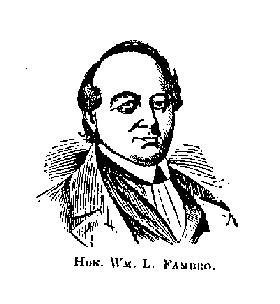
 1.
Wm L. Fambro, President of First Meeting
1.
Wm L. Fambro, President of First Meeting
Of Brother Fambro, Brother James
G. Phinazee wrote: "He was indeed a grand man---- grand in physical, moral
and intellectual proportions – formed in nature’s manliest mold, with Websterian
head, commanding presence, dignity and bearing, such as would attract attention
in any assemblage.
"Originally from Clark county, GA., he came to Monroe
county, Ga., among the first settlers. I have always heard that his literary opportunities,
when young, were exceedingly limited. His native ability was always conceded. {He
read and thought much after reaching manhood} Not so gifted on his feet as an orator
as were some of his contemporries, he was a profound thinker, with clear conceptions
of the right, of decided convictions, and with undoubted courage to maintain them."
Brother Fambro was a successful farmer of rare skill in domestic matters. In a time
when the office sought the man of merit, and not the man sought the office, he represented
Monroe county in the Georgia Legislature. For many years he served as Judge of the
Inferior Court, which sat as a Court of Ordinary and also county purposes. He was
skillful as n organizer and a parliamentarian of ability.
So much for Brother
Fambro by birth and by natural acquirement. Were this all, he might have gained
some applause from worldlings and been the victim of some envy from unspiritual
aspirants. But, best of all, God was with him. He was a man whose nature was spiritualized
by Divine grace and whose rare abilities and earthly goods were sanctified unto
the Lord. In his home the richest and the poorest were alike welcome and shared
in his princely, but unostentatious, Christian hospitality. Mean was the nature
who went away without added warmth and increased aspiration after holiness.
For
a number of years he was a member of the M. E. Church. He was ever in hearty accord
with the Wesleyan interpretation of doctrine: but as he thought he became thoroughly
convinced that Methodist doctrines had been wedded to a polite inconsistent with
them and in some instances interfering with the free exercise of moral agency and
thus hindering the free movements of the Holy Spirit. His nature was too devout
not to act upon his mature convictions. "Thoroughly imbued with the principles
of religious liberty," when a few of his neighbors suggested the founding of
a Church Methodistic in doctrine and Congregational in policy, modified by a harmonious
Connectionalism, he readily favored it and heartily entered into the plan. Quoting
again from Brother Phinazee: "Rejecting all temporizing suggestions, the movement
found in him a bold advocate. * * * A parliamentarian of ability, he presided with
grace and dignity over the earlier deliberations of the Church; he presided over
the Convention of 1855, one of the most notable ever held by the Church; and subsequently
at General Conferences. Skilled as an organizer, his services were invaluable. He
gave his time, money and talents to the building up of the Church and lived to see
it spread beyond his sanguine expectations.
"At length the labors of a long
and eventful life were drawing to a close. His mental powers seemed unimpaired and
he retained much of his physical vigor up to his last illness. He died September
3, 1868. Rev. W. H. Graham (another of the founders) conducted the burial services
from the text, " I have fought a good fight, I have finished my course,"
etc.
"The distinguished citizen, the able legislator, the upright Judge,
the humble Christian, how applicable the words of the text.
"Balaam said,
‘let me die the death of the righteous." Siward, renowned in English history,
when he flet the hand of death upon him, called for his armor and had his sword
placed in his hand, as he said he wanted to meet death in the guise of a noble and
a soldier.
" When conscious of the approach of death, Judge Fambro said, "I
wish to die like a Christian philosopher."
"Honored and beloved in life, mourned in death, his memory is held in lasting
remembrance.
"Upon an eminence which can be seen for miles around, is the
old homestead. On its summit in solitude stands the old mansion built in the long,
long years ago.
" ‘ Here is the lair, but the lion is gone,
Here is the
eyrie, but the eagle has flown’"
May God give us many noble laymen like
him.
(
*** William Lovelace Fambrough, Bn. 27 May 1796, died.. 2 Sep. 1868, Monroe Co.,
GA
The below information is located on Family Search, plus a complete family
history is
included in the "Family Histories of Monroe County, Georgia",
Compiled by Monroe County Historical Society, Forsyth, Georgia.
:
His Father
: William FAMBROUGH, Bn. Abt. 1762, Halifax Co., VA.
Died: Bef. Mar 8, 1937,
Monroe Co., Ga.
Buried: 12 Jan 1837
Married 6 Nov. 1787 by Christopher Robertson,
her father
Wife: Pheba Robertson, Bn. Abt. 1765, Cumberland Co., VA. Died: Ga.
Her father was Christopher Robertson, Mother; Sary (Agnes Sarah) Nichols
Children of William and Pheba:
Allen Gates Fambrough, Bn. Abt. 1800,
Died Bef. 1860 Ga
Robertson Fambrough, Bn. Abt. 1789, Died 1864, Ga.
Keturah
Fambrough, Bn. 1792
*** William Lovelace Fambrough, Bn. 27 May 1796, died..
2 Sep. 1868, Monroe Co., GA
William Fambrough, the father, was son of
Thomas Fambrough and Mary Anderson. Thomas Fambrough was born abt. 1727 in Virginia;
died 1791 probably in Albemarle Va. . His mother was Mary Anderson, bn. 1725, Albemarle
Co., VA.
REV. ABSOLOM OGLETREE
We would
like to present our readers with a picture of this great soul-winner, but there
is none extant. Brother J. G. Phinazee described him as a little stout, weighing
about one hundred and eighty pounds, with hair and eyes black, nose prominent and
a little aquiline, beard thin and a "countenance of which Nature had unmistakably
stamped the seal of honesty. It was just such a face as those in trouble and
distress were glad to meet, so full of human sympathy". His voice was
manly and his appearance distinguished and winsome.
Brother
Ogletree was born in Wilks county, Georgia, in 1811. In the winter of 1844-45
his father moved to Monroe county. Brother Ogletree continued a residence
of that county till his death July 21, 1861. His widow, Mrs. Matilda Ogletree,
and the daughter who is the wife of brother C. G. Harper, still live at the old
home from which he went so peacefully to Paradise that Sabbath morning when opposing
armies were massing for battle on the field of Manassas.
Brother
Ogletree was a successful farmer, though he never craved or accumulated wealth.
Too much of his time and means went for others for that. He realized that "the
earth is the Lord's and the fullness thereof:" that we are not our own; that
we are stewards of the manifold grace of god; and that the principal business of
every saved man is to be a soul-winner.
In early manhood he
began his ministerial career as a local preacher in the M. E. Church, following
the southern branch till the organization of Congregational Methodism in 1852.
While a member of the Methodist Episcopal Churches he served them faithfully and
uncomplainingly; but by practical experience he more and more realized the disadvantages
under which a local preacher labored under the Episcopal system. This led
him to study church governments carefully and to consider apostolic principles and
practices. The conviction grew that the Episcopacy was not thoroughly in accord
with the New Testament principles and practices and that it interfered with the
free moral agency both of preachers and laymen and often hindered and grieved the
Holy Spirit. becoming thoroughly convinced that another organization was needed,
he had the courage of his convictions and the manliness to put them into practical
and immediate operation. Brother J. G. Phinazee declared that it is probable
that the C. M. Church would never have existed but for brother Ogletree. He
also said that brother Ogletree's strength, patience, kindness, tact, great prudence,
determination, experience and knowledge of church government gave him great weight
in the separation from the old church and formation of the new one. "He
was so careful that he made but few mistakes. He served the Church with a
zeal and courage that never faltered and lived to see it spread to other states
and died no doubt assured of its ultimate triumph."
Though
a social and genial man endowed with wit, he never jested or told anecdotes in the
pulpit. So impressed was he with the solemnity and sacredness and responsibility
of the preacher's mission that when he arose to preach his first sermon, he trembled
from head to foot and in a few moments fell as if dead in the pulpit. The
congregation was greatly alarmed. After he was resuscitated, solicitous friends
insisted upon taking him quietly home; but no, he must be about his Father's business.
Pale as a corpse, the reentered the pulpit and with the intense earnestness of a
messenger from the grave he thundered the truths of the Gospel till God honored
his labor and men, women and children wept and trembled and repented and shouted.
Brother Phinazee said: "The essential characteristics
of his sermons were strong common sense, earnestness, sincerity and faith, and the
work was always well done. * * *
The first time I heard him
preach, when I was quite a youth, was from Matthew 3:12: Whose fan is in my
hand, etc. Looking at him and hearing him my youthful mind was impressed with
the realities of his theme * * * With but little knowledge of the rules of rhetoric
or the laws of logic, this unpretending man when thoroughly aroused could lash the
very deep to a storm. I have had the pleasure of hering some trained orators,
both pulpit and forensic, and my opinion is that when all his latent energies and
powers were called into active exercise he had but few superiors. It is recollected
that on one occasion at camp meeting at Rehoboth in 1847 in and exhortation he became
enthused and breathing inspiration, with appeal after appeal the most powerful,
reaching his peroration he quoted Rev. 19:6 with such tremendous emphasis that the
whole arbor seemed full of the sound of his voice. It was perhaps the greatest
display of pulpit oratory ever witnessed at that consecrated plat of ground."
Yet he never attempted display or thought of being eloquent. He had the power
which the mere logician, or rhetorician fearfully lacks. He was full of faith
and the Holy Ghost.
No wonder that years after this godly
man's peaceful and triumphant death, some holy women, being reminded of his sacred
triumphs and the glorious meetings he had conducted by seeing one of his old coats,
were filled afresh with the Spirit and began to shout. Even dead men arose
from the grave at touch of Elijah's bones.
May God give us
a host of preachers in the C. M. Church whose very garments will preach when death
has stilled the tongue.
(End of quote)>
(The following
comments are NOT part of the above article: Absalom Ogletree is buried at
Mt. Vernon Congregational Methodist near Russellville, Ga.
I am
not certain the below is correct because the above article says his father moved
to Monroe County from Wilkes county. The below
information was taken from
Family Search which states his father was William and he died in Wilkes Co. Ga.
I am including the info anyway
but it should be verified.
He was born
Feb. 15, 1811, Monroe Co., GA., Died July 21, 1861, Monroe Co., GA.
Son of William
Ogletree and Mary (Molly) Bird.
William
was bn. 18 Jan 1765, Dinwiddie, Va., Died 29 Jul 1835, Wilkes, Ga.
William was son of John Ogletree, Sr., and Ann Duncan. John was born 1735-1740 Hanover
Cty. Va., Died Aug 7, 1822, Wilkes, Co. Ga.
John married Ann Duncan(d/o Miles Duncan, Sr.), 1759 in Virginia
John's second wife was Piety
Phillips, mar. 1791, Wilkes, Ga.
Absalom Ogletree Married Mathilda Stewart,(Bn.
1814- Died 1910) 1830 (She was daughter of Thomas Stewart and Nancy Jane Russel)
Children were: Mary Jane, Bn. about 1830
William T., Bn. Abt. 1834
James M. Bn. Abt. 1838
John F. Bn. Abt. 1840
Sarah F. Bn. Abt. 1842
Absalom Hardy , Bn. Abt. 1844
Robert David, Abt. 1846
Philemon R., Bn. July 7, 1836
The following are buried in Monroe Co.
Born
Died
Forsyth City Cemetery OGLETREE DAVID JUL. 10, 1809 JAN. 5, 1876
Forsyth City Cemetery OGLETREE PHILEMON F. NO DATE NO DATE CO. A, 14 TA
INF. C. S. A.
Forsyth City Cemetery OGLETREE WM. D. SEPT. 28, 1847 AUG. 23,
1853 S/O D & F H OGLETREE
Ogletree Cemetery Ogletree John B.
Jan. 9, 1873, 75 years of age.
Ogletree William,
Georgia Mil. Revolutionary War.
Ogletree Elizabeth Greer Feb 24,
1802, Mar. 24, 1872 dau. Thomas A. E. Greer and wife John B
Ogletree Little
Absolem, aged
6 years, 1868.
Ogletree Rev. Absolem Feb 11, 1811 July 21,
1861 age 50 years
Ogletree Frances A. Goodrum, Feb
19, 1826, Dec. 10, 1898.
 REV. WILLIAM HARPER GRAHAM
Rev. W. H. Graham, or "Uncle Billy" as we called him in the last years
of his pilgrimage, was one of the twelve men who met
at brother Merritt's in Monroe county, Georgia, in 1852, to inaugurate Congregational
Methodism. He had not enjoyed the
education advantages of some, but was a man of good natural endowments - what
brother Andrew Walker characterized "a diamond in the rough".
He was unmistakably converted at old Rehoboth Campground at an early age and
was thereafter eminent for religious fervor and zeal. Many souls will
rise up even unto the Judgment and call him blessed. Some of those who
despised him because he was not learned and polished will see the day when they
will be glad to exchange crowns with him.
He rarely bade
an unconverted person good-bye without an affectionate word of admonition.
He felt it one of the duties of friendship to be candid and faithful where he
discovered hurtful faults.
in 1892 Uncle Billy pointed
out to me, near Unionville, a farm he lived upon as a renter years ago when
his children were young and dependent. Said he: "Rolfe, there is
where we lived. My wife was an invalid and all that year she lay abed.
Every morning, I would rise early, cook breakfast, wash dishes, dress the children,
wait on wife, fed the stock, sweep the house, then, leaving something in reach
of wife and the children for dinner, I would make my way to the field with my
dinner bucket on my arm. All day long I would toil for our bread, trusting
the sick wife and the little children to God. When the sun was down, I
would go to the house, milk the cows, feed the cattle, cut wood, cook supper,
wash the dishes, attend the wife, put the children to bed, and when the moon
shone do jobs around the place for awhile after all were asleep."
Tears came into the old man's eyes, through which a supernal light shone, as
he added: "Yet, Rolfe, in some respects, that was the happiest year
of my life. I trusted all to God and he blessed me. Right down there
stood a little pine that I passed every morning. Under it I would set
my little dinner bucket while I knelt and prayed. Every evening I would
go home singing.
"How happy is the pilgrim's lot:
How free from every anxious thought:
From worldly hope
and fear !
His soul disclaims on earth to dwell,
He only sojourns here.
*****************************************
"No
foot of land do I possess,
No cottage in this wilderness
A poor wayfaring man,
I Lodge awhile in tents below;
Or gladly wander to and fro,
Till I my Canaan gain."
When I visited Milner in 1892, I found "Uncle Billy"
living here with his second wife, the other having gone to the Land of Health
years before.
After meeting the people, I said: "Uncle Billy, there
are a few Congregational Methodists here who are hold there membership in churches
inconveniently remote and there are others who will be happier in the Congregational
Methodist church. We can organize and build: we must do so.
What do you say?" Said he: "I will donate the lot right
close to my house in that grove and all that I ask is that you all name the
church Graham's Chapel". The neighbors remember how Uncle Billy's
heart entered into the work.
But even before the band
was organized, Uncle Billy was called from us. We called our little band
together, organized, bought another lot, built upon it and the Lord has dwelt
graciously with us at Graham's Chapel.
From May 8-12,
1893, Uncle Billy was with us in General Conference at Unity Church, Floyd county,
Georgia Being the oldest surviving minister of the church, he was called
upon to preach the introductory sermon. He took for his text: "Cur4se
ye Meroz; curse bitterly; for they came not up to the help of the Lord against
the mighty." The venerableness of about seventy years, the glow of
spirituality, and the unction of the Mighty One added to the emphasis, charms,
and effectiveness of that effort. He was in exultant mood throughout the
conference session, and went home with abiding ardor, faith and enthusiasm.
In speaking on the conference grounds of the fast train "Nancy Hanks", "
he remarked: "That train is going to kill somebody; they ought not to let
it run so fast but; Nancy Hanks will never kill me; for I'll never ride
on it!" But, alas, how little we know! On May 28th - barely
three weeks after he uttered the words - both he and his aged wife were instantly
killed by Nancy Hanks. Together they had worshipped at the Milner Baptist
church that Sabbath morning. Uncle Billy had said he was trying to live
every day just as if it were his last , and had led in prayer in most exalted
mood. Together they had started home under separate umbrellas in the beating,
blinding rain on the Central of Georgia railroad track. They had been
warned that Nancy Hanks would soon be along, but Uncle Billy trusted to his
watch which proved few minutes slow. Through the tempest the train
dashed at sixty miles an hour and took the aged couple from life in the twinkling
of an eye. For three weeks Uncle Billy had dwelt in the choicest heights
of the Land of Beulah and had tabernacled on the transfigured mountains.
From these heavenly places in Christ Jesus here on earth, he went, in company
with his wife, with the speed of the redeemed, to the Paradisiacal glories to
which our pilgrim feet are hastening.
 PRESIDENT
GEORGE W. TODD
PRESIDENT
GEORGE W. TODD
May 8, 1852, twelve noble men of Georgia,
in face of opposition and in defiance of what the world might think of it or
do about it, linked their names forever with the history of Congregational Methodism.
One by one these honored founders have exchanged their weapons of warfare for
crowns of victory, and have passed from sacrifice to reward.
They lived nobly: they have died triumphantly. One yet remains in
flesh and blood - the venerable George W. Todd, now in Mississippi.
As were the other founders, brother Todd was an American of the Americans.
His father, Joseph W. Todd, was born and reared in Wilkes county, Georgia, and
his mother, Esther Parker Todd, was born and reared in Hancock County, of the
same state. His parents were married in 1808, January 22nd, and it is said that
theirs was the first marriage license issued in Sparta after the organization
of the county of Hancock. The father was an honest, enterprising, persevering
man of good morals, but belonged to no church. The mother was a devoted
member of the M. E. Church she had four brothers, some of whom were M. E. preachers.
George W., the subject of this sketch, was the eighth of his parents' eleven
children. He was born near Forsyth, Monroe county, Georgia, March 20th
1824. He received such an English education as was provided in the country
academy of his day. He was converted at Rehoboth Camp Ground in 1838,
where several of the associate founders were born anew and were the little band
of Congregational Methodists
first worshipped after their organization at
brother Merritt's. Soon after conversion, he joined the M. E. Church at
Forsyth. With the exception of a brief space when he held his letter on
account of remote residence, he continued an acceptable member of that church
until he became one of the twelve charter members of the Congregational Methodist
church in 1852. He married Miss Mary Elizabeth Phinazee, of
Monroe
County, December 21, 1847. She was a daughter of one of the most distinguished
of the early C. M. leaders - the Rev. Hiram Phinazee.
After some years he moved with her to Newton county, Mississippi. There
in February 1854, she died, leaving two sons and five daughters. November
19, 1865, he married a daughter of another man who has been distinguished in
Congregational Methodism, as well as elsewhere. The bride this time was Miss
Virginia Carolina Jones, daughter of Hon. L. J. Jones, at that time of Paulding
county, Miss. With her he still loves happily, this union having been
blessed with three sons and two daughters.
Brother Todd
has spent his years in Georgia and Mississippi. Until he was eighteen
years of age, he worked on his father's farm in Georgia, occasionally attending
school. When eighteen he took charge of a school that had been tendered
him, and he continued to teach in Monroe County until his widowed sister, Mrs.
McMullan, needed his protection and assistance in Mississippi. Staying
with her until she married a second time, he returned to Georgia, and taught
twenty months at Chapel Hill Academy, near Mt. Zion church, Monroe county.
Then he taught at Collier's two years, after which he bought a farm three miles
east of Forsyth. The next four years he divided his time between farming
and teaching at Jackson Academy and at Forsyth.
It was
in the winter of 1853 he moved to Mississippi, where he still lives. Since
living in Mississippi he has taught some, but most of his lifetime has been
devoted to farming. He has occupied several civil offices both in Georgia
and in Mississippi. He has been the main instrument in founding two institutions
of learning of local importance: Chapel Hill in 1859 and Hickory institute
in 1889, the latter located at Hickory and having nearly 200 pupils. He
has often been called upon to serve his church in official capacity.
Along in the 'forties he was accustomed to hear the renowned Dr. Lovick Pierce
preach and to read his views on church government. With others, broth
Todd's views crystallized into Congregational Methodism, and he rode ten miles
that notable Saturday, May 8, 1852 to cast his lot with the other eleven at
Judge Merritt's. He says that Congregational Methodism has succeeded beyond
his most sanguine expectations and he believes we are on the eve of greater
things than ever. Thinks if our church had never accomplished anything
but its modification of the Methodist Episcopacy, great good would have been
done. But in addition to that, Congregational Methodism has accomplished
much for liberty and salvation through grace in our own ranks.
Many a sinner has shouted out the first joys of the new birth at Congregational
Methodist altars and many noble men and women have shouted their way out of
our visible ranks to the invisible glory.
Brother Todd,
after reflection of fifty years in in the soberness of old age, testifies: "I
do not believe that any of the original twelve had the idea of any emoluments
of pecuniary gain or sinister motive whatever in the course
pursued, but
actuated from purest motives, unprejudiced towards the old M. E. church or its
brotherhood, they simply wanted ecclesiastical freedom as set forth in first
preface of Discipline. The finger of God must have been in the hearts
of most of these men, and it seems that the hand of providence has been shown
all along these years in disseminating the principles of Congregational Methodism
through many of these grand United States of America. "
The first C. M. Church in Newton County, Miss., was organized in Brother Todd's
house in March 1855, but the Rev. Henry T. Jones.
Brother
Todd thinks we should insist upon a higher standard for our ministry; insists
that we educate our people up to a higher plain of duty in supporting preachers
and institutions of the church.
Brother Todd was once
tall and slender, with raven black hair and dark eyes. He is still erect,
is a little heavier than formerly, but his hair and beard are silvered for the
bright world.
He was elected Present of the General Conference
in 1897, and reelected in 1901.
 JAMES MONROE FLEMING
James
Monroe Fleming was the son of James and Celia Fleming, who came to Georgia from
North Carolina.
He was born in Monroe County, Georgia, February 29, 1828.
At seven years of age he lost his father and from that time he was largely responsible
for the support of his mother, brothers, and sisters. At this early age
he was true to his charge and made it manifest that in him were the elements
of success and the principles of a noble gentleman. February 2, 1865,
he married Miss Narcissa A. Butler, who preceded him a few years to the eternal
home Three sons and one daughter survive him, having entered the responsibilities
of manhood and womanhood under circumstances most favorable to piety, success
and usefulness.
As a business man, brother Fleming was
alert, energetic, punctual, systematic and reliable. He had superior judgment
and he prospered in all his undertakings. As a gentleman, he was thoughtful,
considerate and polite, discreet and dignified.
While never unnatural or
stiff, yet there was something in his bearing and character that forbade insult
and restrained evil. As a son and brother he was affectionate and dutiful.
Few young men consecrate so fully and cheerfully as he did the first thirty-seven
years of life to mother and brothers and sisters. As the head of a family,
he was home-living, devoted and affectionate to an unusual degree; yet was firm
and commanding. As a citizen, he was peaceable, quiet and law-abiding,
not influencing his countrymen so much by seeking to lead as by recognizing
the powers that be as of God, and throwing the whole of his heart, energy and
influence, on the side of law and order. As a Christian, he was faithful,
zealous, liberal, constant, consistent and useful. His faith was as pure and
simple as a child's recognizing God in all things that concerned him.
He
believed in a special providence, and he believed that this embraced the material
realm, as well as the spiritual; the temporal as well as the eternal.
He was characterized by a truly Scriptural liberality. He did much to
aid the poor, and no one ever properly presented to him the needs of a helpful
Christian enterprise or institution in vain. After the war, in
his unostentatious way , he gave away, in various directions, more
than $200.00 a year in the name of Christ. He was one of those who in
1852 founded the Congregational Methodist Church and he loved and supported
the denomination to the day of his death. His membership was at Mt. Zion,
about two miles from his residence. and the oldest church in the connection.
We all knew brother Fleming would be at Mt. Zion on meeting day unless providentially
hindered. We trusted him to do his part, and we were never disappointed.
In all things, brother Fleming was regarded as conscientious, courteous, conservative
and safe. He died at his home, surrounded by his children at 3:30 P>
M., Sunday, August 18, 1895. with his business all arranged, his house
in order, he felt death stealing over him, and instead of being alarmed, he
quietly asked the pillow taken from under his head, and as he straightened out,
he folded his hands on his breast, saying peacefully, "Now let me die."
His dying joy at one time found expression in prolonged shouts of praise.
TRAVIS IVEY
Another of the men of faith who met at brother Merritt's that
Memorable 8th of May to organize Congregational Methodism was Travis Ivey.
Brother Ivey was a plain layman, who supported his large family of daughters by
working as a mechanic. He was a modest, quiet man and made no effort at leadership
in the important movement; but he was a man of integrity, whose word was always
relied upon. He was a man of pure heart and clean hands, whose prayers were
full of faith, fervor and power. Often he was called upon to lead the prayers
at church, and so mightily did he wrestle some of those who were little children
then remember his pleadings and praises yet and bless God for the memory.
Much of the strength of Congregational Methodism is due to the prevailing prayers
of plain men who, like brother Ivey, have become princes on their knees. May
the church never be without such men.
(The following comments are NOT part
of the above biography:
According to the 1860 Census, Monroe County, Ga.,
Travis Ivey (Ivy) was born in South Carolina. The following were listed in his household.
Ivey Travise 50
M
Ivey Sarena
45 F
Ivey Eliza A
27 F
Ivey Ann J
25 F
Ivey James
19 M
Ivey Julia
17 F
Ivey Sarah
15 F
Ivey Elizabeth
13 F
Ivey Z T
10 M
Ivey Fannie
6 F
Ivey B F
2 M
Return to Church Index
Return to Home Page
Compilation Copyright 1997 - Present by The GAGenWeb Project
Team
