THROUGH
MOUNTAIN MISTS
Early Settlers of Union
County, Georgia
Their
Descendants...Their Stories...Their Achievements
Lifting the
Mists of History on Their Way of Life
By: Ethelene Dyer Jones
To
Nagasaki After the Atomic Bomb Blast
Significant events in the
history of our
country and World War II—the dropping of atomic bombs on Hiroshima and Nagasaki, Japan
respectively on August
6, 1945 and August 9, 1945—led to Japan’s unconditional
surrender signed aboard the
battleship Missouri
in Tokyo
Bay on September 2, 1945.
At
the Potsdam Conference held July 26, 1945, leaders of
the United States,
Great Britain
and the Soviet Union issued an
ultimatum to Japan
for
unconditional surrender. Japan’s
leader
refused to surrender. President Harry S. Truman made the crucial
decision to
bomb two Japanese cities. It is almost
certain that if that decision had not been made, the United States
would have invaded Japan
and many
more people, both American, our allies, and Japanese, would have died
in a
bitterly-fought extended war after the peace in Europe
had been signed.
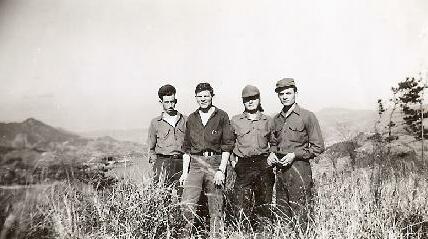
RSp3
Grover D. Jones and buddies Harlor, Bridges and Jack Jones,
shipmates,
on a mountain outside Nagasaki,
Japan,
1945.
Navy Radioman Third Class Grover
Duffie
Jones and his crew were ordered to Nagasaki Bay
for occupation duty
shortly following the dropping of the bombs.
Their mission was to restore communications.
From his autobiography he wrote about this
assignment. Because of the significantly
historical nature of his (my husband’s) account, I share from it here:
“Occupation duty would be dangerous,
even though fighting had ceased. Little
did we know how very dangerous the assignment would be, for the
aftermath of
atomic fallout had not been studied extensively by scientists.”
Deployed from their main troop ship
from a harbor in Hawaii,
the radio crew and their officers and the radio equipment they needed
were
loaded onto an LST (Landing Ship Tank) and made the treacherous journey
from Hawaii
through storms at
sea, finally arriving at Nagasaki
Harbor.
Grover Jones continues in his
journal: “A US Marine crew had arrived
at Nagasaki
some days before us and had established a base out in the mountains
some few
miles from the docks. The facility had
been a prisoner of war building until the surrender of Japan.
“We were assigned to occupy what had
been the customs building about six miles toward the entrance of the
harbor. We quickly unloaded and were
able to set up quite comfortably in those quarters.”
He follows with details of how they
established radio communication. Then
about the destruction from the atomic blast in the area where the
Marines and
Navy detachments were housed, Jones wrote:
“During my stay in Nagasaki,
I made only one trip into the edge
of the city. That part of Nagasaki was on
the outer
edge of the area struck by the atomic bomb.
It had relatively small damage compared to the worst-hit
sections. The people there who had
survived the blast
had unbelievably high respect for the American armed forces. They had brought an end to the terrible war
the country had suffered for several years.
“A short distance from the part of the
city we were in was utter destruction.
Nothing remained. Within walking
distance from the dock was the metal framework of a giant two-story
building. It looked as if a giant hand had
reached down
and pushed the building toward the ground.
The metal framework was twisted in every direction.
No vegetation survived near the building.
“No warning was ever given to us that
atomic radiation was there and might affect our bodies and possibly
cause death
or disease.”
The
Navy detachment was successful in
its mission to restore communication from Nagasaki
to other American forces and ships in the general Pacific area. With that task completed, Seaman Third Class
Grover Duffie Jones and his crew were sent on the long journey through
stormy
seas on a hospital troop ship back to the United States.
They landed in Seattle,
Washington
in the midst of a bitter winter storm in January of 1946.
Even his deployment from Seattle to Jacksonville, Florida
for discharge from the Navy was frought with true stories of survival
during a
blizzard and severe winter weather in his westward travels on his way
home.
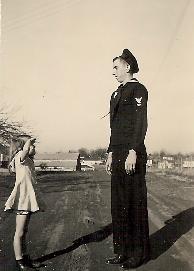
His
niece Betty Wilson salutes her uncle, RSp3
Grover Jones
He
was honorably discharged from the U. S. Navy on February 11, 1946. He had been inducted on December 11, 1943 and
entered active
service on December
18, 1943. His record reads that
he had a period of active service of two years, two months and one day. He wrote this at the end of his
autobiographical sketch of his Navy service:
“I returned home much older than the eighteen-year-old lad who
left in
the midst of wartime, and, I hope, much wiser for my experiences.”
Throughout several months of 1946, he
suffered from a severe attack of painful arthritis, which rendered him
unable
to walk and in bed most of the time. He
suspected, but neither he nor the doctors knew for sure, that the
arthritis may
have resulted from atomic fallout during his months in Nagasaki Bay. A
faithful family doctor in Gainesville,
Georgia
where he then lived worked hard to pull him through that health crisis.
He
recovered enough to walk normally, but arthritis in one form or another
was an
ailment from which he never fully recovered for the remainder of his
life to
age 85 when he died on January 26, 2011 at Georgia War Veterans Home.
RSP3
Grover Jones was one of “The Greatest Generation,” that lofty,
patriotic, brave group of servicemen whose love for God and country
stand out
as exemplary in the annals of our nation’s history.
<>
c2011 by Ethelene Dyer
Jones; published Feb.
10, 2011 in The Union Sentinel, Blairsville, GA.
Reprinted by
permission. All rights reserved.
[Ethelene Dyer
Jones is a retired educator,
freelance writer, poet, and historian. She may be reached at
e-mail edj0513@windstream.net;
phone 478-453-8751; or mail 1708 Cedarwood Road, Milledgeville, GA
31061-2411.]
Updated May 28, 2018
Back To Union County, GAGenWeb
Site