THROUGH
MOUNTAIN MISTS
Early Settlers of Union
County, Georgia
Their
Descendants...Their Stories...Their Achievements
Lifting the
Mists of History on Their Way of Life
By: Ethelene Dyer Jones
A Trip West in
1873 - From the Memoirs of James Nix
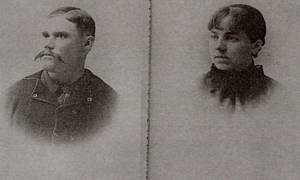
James
William Nix pictured in 1881, 8 years after he left Georgia for
Colorado.
Pictured beside
him is his fianc�e, Iona May Copp.
The
couple married January 2, 1890 in Norwood, Colorado.
Elizabeth
Souther Nix had the spirit and determination of a
true pioneer. She set out from
Choestoe
District; Union County,
Georgia
on March 24, 1873,
nine years after her
young husband, William Nix (1837-1864) died and was laid to rest in Old Choestoe Cemetery. That cemetery also contained the grave
of
her second born child, John B. Nix (1860-1862).
In her research of what we call “the
western Southers,” Diana Lee Greagar found an invaluable document that
lends
much light on a young widow’s trip with three young children as they
migrated
west. The account is in the form of
memoirs written by Elizabeth and William Nix’s eldest son, James, who
was born December
26, 1859 in
Choestoe and died in Boise,
Idaho March 2, 1947. James was not quite fourteen when he, his
mother Elizabeth, and his sisters, Martha Jane (1861-1949) and Nancy
Ann
(1863-1899?) left Choestoe going west.
Elizabeth Souther and her three
children were in the company of others from Choestoe who were likewise
heading
west. Her brother, William “Bill”
Souther had already gone west to Colorado. Evidently
his letters home had put a spark of
hope in his sister’s heart. Nine years
after her husband William’s death, Elizabeth
looked at the mountains surrounding the small farm on Choestoe where
she had
tried to eke out a living for herself and her three children since
Will’s
untimely death. Unknown lands beyond
familiar hills and valleys seemed to beckon her. She
hoped there was a better way to make a
living than her small farm on Choestoe afforded.
Jim wrote in his memoirs: “Father
and Mother lived on Town Creek in
Choestoe District on a high knoll or ridge overlooking a small valley
where
brother and sisters and I were all born and where I put in my happiest
childhood days. Our school house and
church when we left that part of the country was named Liberty.”
James Nix had recollections of the
Civil War as it affected Choestoe. He
mentioned the “rallies” and the “mustering days” when able-bodied men
volunteered for service, or, if opposed to joining with the Confederate
forces,
either hid out in the mountains to escape service or, if aligning with
the
North, went to Tennessee
where they joined the Federal Army. Jim
Nix does not write whether his father lost his life due to the war or
through
natural causes in 1864. James also
remembered what he called “the miserable pilfering parties” that robbed
Choestoe homesteads. “The Union Army ran
them out near the end of the war,” James wrote.
The Nix family loaded their wagon with
enough provisions to get them from Choestoe to Cleveland, Tennessee,
several days journey over the narrow road along the Ocoee River Gorge
then used
to transport copper ore from the mines around Ducktown and Copperhill, Tennessee
to the railroad in Cleveland. Since others from Choestoe were in the
wagon
train (unfortunately Jim does not name the other families in his
memoirs),
Elizabeth and her three children had some protection as they camped
along the
way.
In Cleveland, they “stayed for a few
days,” (still camping out in the wagons) where they dickered with the
railroad
for fares west to Colorado. James wrote, “Finally, the different
families, consisting of quite a number, got them down to $35 dollars a
ticket
and baggage free.” Think how long
Elizabeth Souther Nix must have saved up to have that amount of money
in 1873
for herself and three children to go west.
Being an enterprising woman, she no doubt found a place in Cleveland to
sell her
mule team and wagon to add a little more cash for the journey west.
James Nix gives their itinerary from Cleveland, Tennessee: “We took the train for Colorado by way of Chattanooga, Tennessee,
Mobile, Alabama,
and Corinth, Mississippi where we lay over for a
few
days.” Layovers meant more
outlay of
cash for the young widow and her three children. They
would have found lodging in a boarding
house or hotel of that day. Meals would
have been another cost, for it is not likely that Elizabeth would have had a means of
preparing
food for them. At Corinth they did some sightseeing. He wrote, “We looked over the breast works
thrown up in the Civil War.”
Next on the rail stop was Union City, Tennessee
and then on to Columbus,
Kentucky.
There they had to cross the mighty Mississippi
River by boat, which ferried the railroad coaches across. Although James Nix writes only
matter-of-factly about this experience, we can imagine the excitement
felt by a
fourteen year old lad and his sisters, Martha Jane, 12, and Nancy Ann,
10, as
they saw the great river from the windows of their railroad coach as
the ferry
laboriously edged to the western bank of the Mississippi.
“Then we took the Iron Mountain to St.
Louis, Missouri, where we stayed a day and looked it over, such as the
piers
and abutments of the Eads Bridge (to be),”
he wrote. The Eads Bridge
was under construction in 1873. James
continues, “But only the telephone wire was stretched across it at that
time,
and that was a wonder to me.” He had
not known telephones in Choestoe
Valley in his
childhood. Certainly that technological
advancement would have been “a wonder” to the curious lad from Choestoe.
From St. Louis
the next major stop was Kansas
City. They had
taken the Wabash Railroad. The Missouri River
had risen from the spring rains and melting snow and a washout had
occurred. The people, livestock and
baggage had to be transferred from the train.
“We finally got to Kansas
City, Kansas,”
he wrote, “and laid over
again.” He wrote about “the main
interest there” being a prairie dog on a chain used to entertain
passengers. The animal could burrow
under the side of the platform and was a diversion for travel-weary
passengers,
especially the children.
“We left Kansas City,
as I recall, about ten at night
over the Kansas-Pacific Railroad for Denver, Colorado. We traveled that night, the next day, and
night.”
They
arrived at the Denver,
Colorado rail depot about 9:00 a. m. on April 7, 1873. Since March 24, when they had left Choestoe,
the Nix family had been traveling fifteen days, not a bad record for
that
time. “It snowed about four inches the
night we got to Denver,”
James wrote. “After daylight we could
see buffalo running across the rolling prairies from our train, which
was a
wonder to me.” [To be
continued.]
c2004
by
Ethelene Dyer
Jones; published July 8, 2004 in The Union Sentinel, Blairsville,
GA.
Reprinted by permission. All rights reserved.
[Ethelene Dyer
Jones is a retired educator,
freelance writer, poet, and historian. She may be reached at
e-mail edj0513@windstream.net;
phone 478-453-8751; or mail 1708 Cedarwood Road, Milledgeville, GA
31061-2411.]
Updated June 18, 2018
Back To Union County, GAGenWeb
Site