THROUGH
MOUNTAIN MISTS
Early Settlers of
John Their
Descendants...Their Stories...Their Achievements
Lifting the
Mists of History on Their Way of Life
By: Ethelene Dyer Jones
|
|
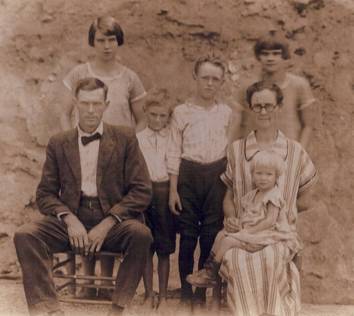
The Juan Wellborn Reece and Hannah
Emma Lou Lance Reece Family about 1925. On Emma's lap, Emma Jean
Reece (b. 03/29/1923). Standing (l. to r.): Eva Mae Reece (b.
08/25/1911); Byron Herbert Reece (b. 09/14/1917); T. J. Reece (b.
07/30/1915); and Nina Kate Reece (b. 06/16/1914). The first born child
in the family, Alwayne, died at age 13 months with meningitis. |
He was tall and lanky, a man of
the earth,
a mountaineer. He was a farmer, a poet,
a genius, a novelist, a philosopher.
Byron Herbert Reece was born on
It’s not that
rabbits ever
really danced here,
Though sometimes in the dusk when
nothing happens
We could believe they danced and
wish them dancing;
They came to sport forever in the
name our country bears,
One that the Indians gave it.
The son
of Juan (pronounced Jew-ann) and Emma Lance Reece, the
poet-to-be, had one brother, T. J., and three sisters, Eva Mae, Jean
and
Kate. Another sister, Alwayne, died in
infancy.
Life was hard on the dirt farm along
Emma Reece recognized early-on the
precociousness of her son, Byron Herbert (whom they had named—not for
the noted
English poets Lord Byron and George Herbert, but for Byron Mitchell, a
hog
trader from Gainesville, and for Herbert Tabor, an insurance salesman
from
Ellijay, both of whom were friends of the Reece family).
Emma read to her children from the
King James Version of the Bible and from John Bunyan’s The
Pilgrim’s Progress.
Before “Hub” (as Byron Herbert was called) began school at
Days found Reece working hard on the
farm. His parents were both beset with
tuberculosis and more and more of the farm work became Hub’s
responsibility. As he worked, he
listened to the melody of
At night by an oil lamp, he wrote with
a passion and expertise uncharacteristic of one with his limited
education. That is why, when his poems
began to be published, some critics questioned both his genius and his
ability
to phrase such flawless verse.
The lyrics of literally hundreds of
poems came from his pen. Ballads,
sonnets and lyrical verse were his forte.
He pursued themes of death, wind, time, the brevity of life,
changing
seasons, nature, beauty and innocence.
Many of these thoughts tortured Reece in his life.
And upon reading his poetry today, his
concerns haunt readers as they contemplate his short life and tragic
death.
Nights were short on rest, days filled
with tasks taxing to his waning health, for he himself contracted the
dread
tuberculosis. He arose to seasonal
duties: turning the land, harrowing,
seeding the rows in spring, cultivating in summer, harvesting in fall. Winter had its tasks: wood
to keep the fires going in the Reece
house, livestock to feed and tend, fences to mend, and poems and novels
to
write.
Many of his poems speak of the earth
and its call upon his time and energies.
In “The Stay-at-Home” (1955) he wrote:
The fields
of Hughly held him,
The land where he was born;
With fence to mend,
And cows to tend,
And care of wheat and corn.
He had no lief to wander
Beyond his place of birth,
But often he would ponder
The luring lands of earth.
When a
critic claimed Reece’s farm life was just a pose and
wanted to know ‘Why not write full-time and leave the farm work to
someone
else?’ Reece’s cryptic reply was,
“Anybody can plow potatoes, but no one is willing to plow mine but me.”
In an article he wrote for The Atlanta Journal
and Constitution
Magazine for
“On a small
farm on
c2003 by
Ethelene Dyer
Jones; published Oct. 30, 2003 in The Union Sentinel, Blairsville,
GA.
Reprinted by permission. All rights reserved.
Back To Union County, GAGenWeb
Site