Crawford County GA History
Crawford County was created from Houston
County in 1822. It was named for United States Secretary of War and Treasury
William
Harris Crawford. Before 1822, the area was inhabited by the Muskogee
people, called Creeks by the Europeans.
*****************************************************************************
 |
In 1775 naturalist William
Bartram, traveling across Georgia, found a previously unknown plant
in Crawford County. He named the plant Hydrangea Quercifolia — now
commonly called Oakleaf Hydrangia. Bartram described the area near
Sweetwater Creek as a "delightful diversified rural
scene," noting that it "promises a happy, fruitful and
salubrious region." See The Botanical Explorations of
William Bartram in the Southeast by David H. Rembert Jr.,
Department of Biology, University of South Carolina -- article and
picture courtesy of Bartram
Trail Conference |
**************************************************************************
Benjamin
Hawkins was
appointed in 1796 as U. S. Indian Agent South of the Ohio River. He
developed the Creek Agency on the eastern banks of the Flint River at the
Lower Creek Trail, which would later become the Federal Road. Hawkins moved
into his house at the agency in 1801 and died there in 1816. Diagram
of the agency headquarters
***************************************************************************
The oldest church in the county, Society
Hill, was organized in 1815. The first church organized after the formation
of the county was Mt. Paron (Paran). The Echoconnee Association was started
at Mt. Carmel Church.
***************************************************************************
Knoxville was designated the county seat
in 1823. It was named for Col.
Henry Knox, Revolutionary War hero, and Secretary of War from 1785
to 1794.
***************************************************************************
| Joanna
Troutman lived
in Knoxville when she made a flag for Georgia troops leaving to join
in the fight for Texas independence. That flag was first flown at
Velasco Jan. 8, 1836, was hoisted along with the Bloody Arm flag at
Goliad on news of the declaration of independence March 8, 1836, and
was one of the inspirations for the Texas Lone Star Flag. |
***************************************************************************
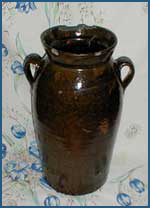 |
Pottery was a thriving business
in Crawford County during the 1800s and early 1900s . Names like
Long, Becham, Merritt, and Dickson were known throughout the area
for their utilitarian jugs and crocks. Clay from Crawford
County and the Rich Hill alkaline glaze used by the early "jug
makers" is still prized today. |
***************************************************************************
| Travelers
through present day Roberta might never guess that at one time it was
a thriving tourist town with several motels, restaurants and gas
stations. US Hwy 341 was the main north-south thoroughfare through the
state, and US 80 took travelers to Texas and beyond. |
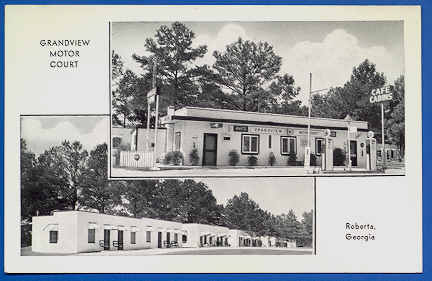
Grandview
Motor Court, Roberta, GA |
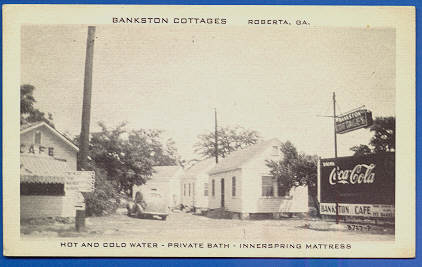
Bankston
Cottages, Roberta, GA |
|
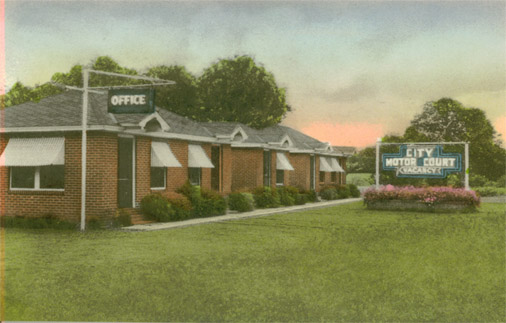
City Motor
Court, Roberta, GA
|
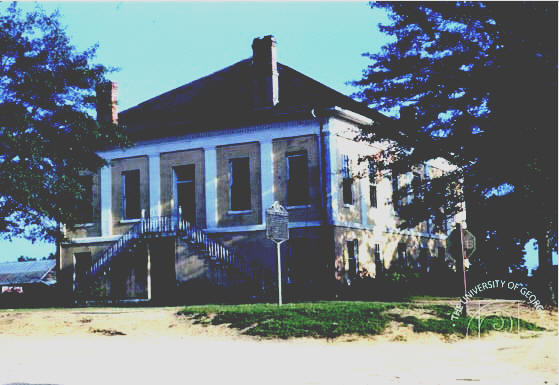
Crawford
County Courthouse, Knoxville, GA
Image Courtesy University of Georgia |
|
|
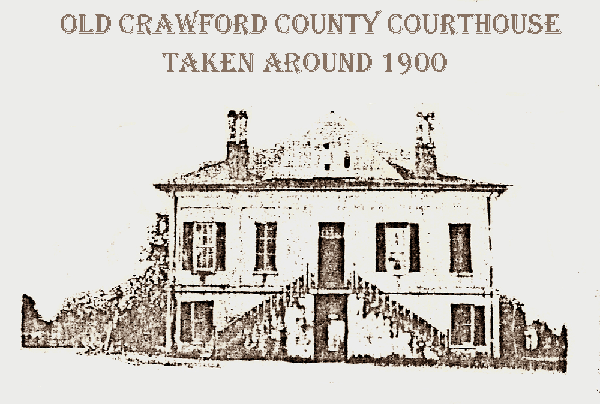
Xerox copy,
Crawford County Courthouse, Circa 1900 |
|
***********************************************************************
Courthouse
History
Two weeks after
the legislature established the county it authorized the initial inferior
court to select a county seat and provide for construction of a courthouse
(Ga. Laws 1822, p. 23). The home of Imlay Vansciver was to serve as a
location for courts and elections until the courthouse could be built. The
legislature designated
Knoxville
as county seat a year later. Inferior Court minutes of May 1830, refer to
records “destroyed by fire when the courthouse was burned.” One historian
has dated the fire to February of that year. Whether a courthouse had been
built or the Vansciver home burned is unclear. Since marriage records
survived, they may have been stored elsewhere.
In August, 1830,
the county treasurer was ordered to pay Henry Crew $200, but there is not
indication of why. The county grand jury meeting in September objected to
the payment, “which was paid without any order of court.” Henry Crew was
builder of the 1830-1831 courthouse. Had he built an earlier courthouse or
did the objection refer to construction already begun on a second? The grand
jury presented “as public grievance the letting and building of the Court
House in the county aforesaid as it does not appear of record . . . of
public notice given. We therefore protest against an order prepared in favor
of Henry Crew for the building of said Court House.”
Superior Court
minutes of Sept. 2, 1830 record the grand jury’s presentment finding the tax
collector’s records correct except for the payment of $200 to Henry Crew
“which was paid without any order of court. We . . . find a balance of
$137.33¾ . . .(We) recommend the Inferior Court of this county appoint a
committee to examine the actings and doings of all former treasurers. . . We
present as public grievance the letting and building of the Court House in
the county aforesaid as it does not appear of record . . . of public notice
given. We therefore protest against an order prepared in favor of Henry Crew
for the building of said Court House.”
In January 1831,
the treasurer was ordered to pay Crew $300. In April, E. W. Dennis was to
be paid $301 “provided the courthouse is finished by the first day of July
next; that is to say finish the floor above and below, run two stair cases
and banisters to same, make three partitions above with panel doors and
furnish locks for same, make a circular table, make seats, in the jury
rooms, make two jury boxes and rough cast the underpinning, all to be done
in a workmanlike manner. This order payable when the above mentioned work
is received by the
Inferior Court
.”
Over the years,
repairs and remodeling have included changes in the exterior finish and
construction of a small addition in the late 1960s. For many years Crawford
was the only county in
Georgia
in which an unincorporated community served as county seat. The courthouse
was used until August, 2002, one of the oldest still in use in the country.
In the minutes of the
inferior court dated May 30, 1830, the clerk was ordered to copy in
"substance" instances of the court prior to February 1830, and that it be
established record in lieu of the lost originals. All of the records were
lost when the courthouse was destroyed by fire in February of 1830.
Since no records were
found of the minutes of meetings of the inferior court from May, 1830 to
April 27, 1831, the details of planning the courthouse or the manner of
letting the contract is unknown.
April 27, 1831 - it
was ordered that the county treasurer pay E.W. Dennis $301.00 out of any
monies in hand not otherwise appropriated, provided the courthouse is
finished by the first day of the next July (finish the floor above and
below, run two stair cases and banisters of the same make through partitions
above with panel doors, furnish locks for same, a circular table, seats in
the jury room, two jury boxes, and roughcast the underpinning). This order
payable when the above mentioned work is received by the inferior court. On
the same date, a Henry Crews received $999.00 from the inferior court in
full payment for the courthouse so far as it is finished.
July 18, 1831 - when
the court met in Chambers, it ordered that the county treasurer pay Henry
Crews $50.00 for extra work done on the courthouse. The money to be paid
out of monies not otherwise appropriated. It was also ordered that the
courthouse be received so far as the same is completed and that William
McGee, tax collector, be authorized to pay Henry Crews $301.00 in full
payment for completion of said courthouse agreeable to an order paid
heretofore.
January 25, 1832 - the
inferior court ordered that Joseph Bemille of Macon to be paid by the county
treasurer the sum of $270.00 for plastering the lower rooms of the
courthouse.
**************************************************************************
From the Macon Telegraph
Posted on Sun, June 6, 2004
Old Crawford courthouse slated
for restoration

Crawford County Historical Society looking to raise
$500,000 to turn building into museum
By Sharon E. Crawford
Telegraph Staff Writer
KNOXVILLE
- Workers have spent the last few years chiseling off layers of
sheetrock and paneling inside the old Crawford County Courthouse.
Since the courthouse was built in
1851, its walls of brick and wood have been covered and spackled and painted
to hide their former beauty. The eight fireplaces have been bricked up, and
the several chimneys removed.
Now, members of the Crawford County
Historical Society want to raise $500,000 to restore the building and turn
it into a museum that will showcase the county's history.
"In those days, brick was
considered trashy," said Kathleen Cook, a member of the Crawford County
Historical Society and chairwoman of the restoration project. "No one
wanted to have a brick building ... so they covered it up."
So far, the group has raised more than
$20,000 in grants and donations to get the project under way. Some of the
money has been spent to have the building inspected, Cook said.
"We just have to take it a piece
at a time," Cook said.
Although local historians thought it
was built in 1832, Cook said recent research shows the courthouse was built
almost 20 years later. The two-story structure - which has no indoor
stairway - housed the county's offices for more than 150 years. People
attending court had to walk up the stairs in front of the building.
"There is a lot of history in
this building, and we want to preserve that," Cook said. "We want
future generations to know where they came from."
Crawford County Sheriff Kerry Dunaway
said his deputies had to lead inmates to court up the same stairs victims
and their families had to walk. During routine court appearances, inmates
would sit in the jurors' deliberating room.
"When they built the courthouse,
they didn't have all these court hearings," Dunaway said. "The
sheriff would make a bond and people would come to court once or twice a
year. They built the courthouse so it would be a day's ride from anywhere in
the county. ... If the jurors were late deliberating, they would sleep in
the loft of the courthouse."
Over the years, the county outgrew the
old building and made plans to build a new $2.6 million facility. In 2001,
all county offices were moved to the new building down the street.
Since then, the old courthouse has
been vacant - except for an old steel safe, shelves of Georgia law books
dating back to the late 1800s and old county ledgers. It didn't take
historical society members too long to realize they wanted to preserve the
building and the items inside it.
"We're going to restore it to a
museum and showcase what is unique about Crawford County," Cook said.
The group also wants to recreate an
old 1800's school room and court setting inside the museum.
Mandy Elliott, revolving fund
coordinator with the Georgia Trust for Historic Preservation, said Crawford
County's efforts to restore the old courthouse is a positive venture. She
said it will probably take funding from both public and private funding to
see the museum open.
"We're trying to develop a
statewide program to restore our old city halls and courthouses around the
state," Elliott said. "In the meantime, it's a project that has to
be done on the local level."
Cook said the group hopes to open the
new museum in 2009.
*************************************************************************************
Historical Sites
in Crawford County
Crawford
County in Retrospect
Georgia Masonic
Lodge
Laws &
Ordinances of Roberta, Georgia for 1904
Original
Settlers of the County
Greatest Tragedy in Crawford County History
Crawford
County Historical Society
Newsletters
|
Crawford
County Historical Society
P.O. Box 622
Roberta, GA 31078-0622 |
|
Newsletters
|
|
Newsletters are pdf
files so be sure you have Adobe Acrobat Reader to be able to read the files.
|
Last Updated
Wednesday, April 16, 2025
Copyright ©
for The GAGenWeb Project All Rights Reserved
Back to Crawford
County GAGenWeb